Showing posts with label event. Show all posts

Sunday, 14 August 2016

The Poet Laureate at the Edinburgh Fringe

A storm erupted shortly after I sat my English GCSE back in 2008: the examining board AQA had decided to remove a poem by Carol Ann Duffy because one exam invigilator thought it would incite knife crime amongst youths. 

On learning this, the first thing I did was pick up my AQA text book and turn to the poetry section we hadn’t had to study, and I read the offending poem. My immediate thought was ‘I wish we could have studied this group of poems instead of the other group’, soon followed by, ‘that’s such a surface reading, even I can see that’s not the point’. 

‘Surely,’ I thought, with all the smugness of a 16 year old who had just attained a decent grade in my GCSE, ’surely if the invigilator had sat the exam, they would have failed.’

Carol Ann Duffy
The offending poem, as it appeared in the AQA text book
On Wednesday, sitting in a small theatre in Edinburgh, I was transported back to that moment when I read Carol Ann Duffy’s work for the first time. But on that afternoon I had the privilege of hearing the Poet Laureate read her work aloud, including her scathing response to that absurd move by AQA.

After discovering her writing that day I continued to read Duffy’s poetry, and it was especially wonderful to hear her read two of my favourites from her World’s Wife collection, Mrs Aesop and Mrs Faust.

She was a captivating speaker, accompanied by John Sampson with musical interludes that neatly segmented the performance and underscored various poems (Danny Boy softly played underneath Carol Ann’s reading of Premonitions very nearly reduced me to tears). 

This poem is from her collection, The Bees. Sometimes the synchronicity in my life astounds me.


If you missed Carol Ann Duffy’s show in the Fringe, you can still see her at the Edinburgh International Book Festival where she is appearing with Jackie Kay on the 17th and Gillian Clarke on the 18th. (The book festival is amazing and I highly recommend it! I had the good fortune to see Marina Warner speak last year!)

Tuesday, 25 August 2015

Marina Warner speaks at the Edinburgh International Book Festival

Today I had the great privilege of hearing Marina Warner give an inspiring and engaging talk on The Fairy Way of Writing as part of the Edinburgh International Book Festival. The event was sold out, and a diverse queue of people had already snaked around half of Charlotte's Square, home of the festival, when I arrived. Conversation in the queue was excited, lively and intelligent, and at the end of the talk audience members asked very insightful questions; I don't think I've ever been in a room full of so many people passionate about fairy tales. What a buzz!

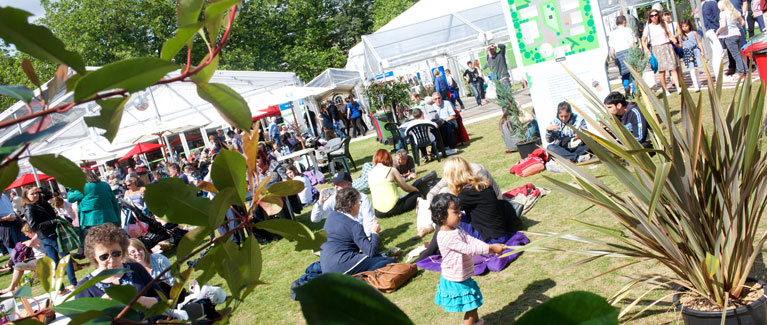
crowds gather in Charlotte's Square at the Edinburgh International Book Festival
Charlotte Square. Image source: Edinburgh International Book Festival
After a glowing introduction, Warner began by talking about the 'territory of enchantment' and the language of imagination. She highlighted the importance of children in the transmission of stories, as historically they would have been the ones to more easily pick up new languages and introduce their stories to the new places they arrived in. The transmission of fairy tales can be mapped like trade routes in this way. And yet, despite this, it is impossible to know how and where they started.

She played us a beautiful ballad by Emily Portman, 'Two Sisters' (The Glamoury, 2010) based on the story of the singing bone. This was used to show that the story itself is not only a fairy tale, but the singing bone (in the form of a harp) is transmitting its own fairy tale, sharing its learned experience to a new audience. The act of the tale within the tale itself.

Warner took us on a whirlwind journey through time to link the tales to the tellers and the situation of the telling, from the 15th century, through the familiar names of d'Aulnoy, Perrault, Grimm (and most pertinently to her audience today, Lang) right up to the present day where we have women at the helm in Disney's animation studios. Particular note was given to Jennifer Lee, screenwriter and co-director of Frozen.

girls react positively to female empowerment messages in Frozen
image source: incredible gifts

Some good points were made about Frozen; it is the highest grossing Disney film of all time, and girls have reacted positively to the messages of female solidarity. I do wonder why, then, we're still seeing the girls dress up and idolise Elsa rather than Anna (the rescuee rather than the rescuer) ...but then my less sceptical side reminds me that Elsa has magic powers, and that must be pretty awesome and factor into the equation somewhat!

One thing I never would have expected was an interpretation of Frozen as a commentary on our state of mind in the digital age. Elsa is stuck in the idea of her own image, and that limits her abilities socially (like the obsession with how we come across on social media platforms such as Facebook) until with a little bit of passion and dynamism she is able to live life fully in the moment (not worrying about how it will later look uploaded!) and she thaws and is able to enjoy herself more because of it.

platform 9 3/4 is the gateway to the territory of enchantment and wonderment in the universe of Harry Potter
image source: collider
I was also pleased to hear her critique Richard Dawkins and his comments last year, when he berated parents for reading fairy tales to children. You can read her full counter attack on The Observer website. Without going into that argument (we've all done it already), Warner reiterated her counter argument on behalf of team fairy tale perfectly: we don't all go and queue up in King's Cross Station because we believe that if we push that luggage cart handle we'll be transported to Platform 9 3/4; we do it because we believe it will be fun to pretend.

And it is that belief that makes us come back time and time again to the territory of enchantment and wonderment. We may not know how it started, but I'm pretty sure it will never end.

Thursday, 20 November 2014

Immerse yourself in Grimm

So THIS is happening in London until February next year...


Grimm tales (not the usual culprits either) in the form of immersive theatre at The Bargehouse. Exciting stuff!


WHAT TO EXPECT, FROM OUR CREATIVE PRODUCTION TEAM:


Philip Wilson (Director & Adapter):
"I love the fact that, in German, these are known as 'wonder tales' rather than the more twee term 'fairy tales': and so audiences coming to the Bargehouse will find themselves plunged into a parallel universe in which extraordinary adventures happen - and the darker side of these stories will come to light... "
Val Coward (Producer):
"We’re transplanting Pullman’s Grimm Tales into the raw, atmospheric rooms of the iconic Bargehouse. It’s a real flesh-and-blood rendering; you’re literally in the witch’s cottage with Hansel & Gretel and you can really sense the magic and delight in the players and audience as each story unfolds. We’re so excited to be bringing these tales to the South bank and everyone here will enjoy this, from kids and their grown-ups to the rest of us who enjoy a fantastic tale or two."

Tuesday, 2 September 2014

Discovering British Folk Art

I'll start off with some honesty: although I do occasionally go out to look at art, I'm not much of a gallery person. That's not to say I don't value and appreciate art, but at best I find galleries too much to take in, and at worst a nesting ground for pretentious sorts who are somehow able to interpret an artist's socio-political viewpoint from a particular brushstroke (and will scowl down their noses at you if your view is 'I like the colours in this one').

So despite being excited about the British Folk Art exhibition I was slightly wary going in. But I needn't have worried - none of my fears were realised. A subject as vast and varied as 'folk art' could have filled endless rooms and corridors, but Tate had about four rooms with themed selections that not only made it manageable, but interesting too. Of course there were some proper art buffs milling around, but their mutterings weren't audible over the hums of conversation between all the other diverse groups of people in there. What particularly stood out for me in this respect was seeing children genuinely engaged with the pieces. Your experiences may differ from mine, but for the most part when I've passed children in galleries or museums I've usually caught a 'this is so boring' or 'can we go home now?', not 'look, this is so cool!' which I heard a young boy say to his mum about the giant keys and boots used as shop signs.
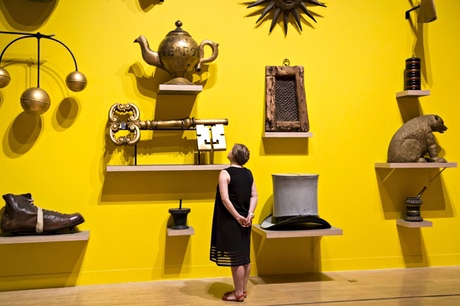
Wall of trade signs (from The Guardian)
The exhibition was hailed as a celebration of objects made outside the British mainstream over the last few hundred years, and was the first of its kind. 'At its foundation in 1768-9, the Royal Academy declared that "no needlework, artificial flowers, cut paper, shell work, or any such baubles should be admitted" to its prestigious exhibitions...' and examples of all of these, and much more, were featured.

Like I said, I don't know much about art; this is merely a few paragraphs about the things I found most interesting or beautiful, and I hope that many more of you have the chance to see the exhibition as it leaves the Tate and travels onward.

Two variations of 'The Earthstopper' by George Smart
George Smart (c.1775 - 1846) was a tailor in Tunbridge Wells who made collages out of textile and paper scraps. Smart reproduced his pictures to sell, resulting in many variations of his work. The exhibition featured different versions of 'Goosewoman', 'Old Bright the Postman', and 'The Earthstopper'.

Two walls were dedicated to the sea, the sky and land - common themes in folk art. They featured lots of wool-on-canvas work such as embroidered maps of the country, counties and solar system - even the layouts of farms. There were also several ships and seascapes usually made by retired sailers and fishermen, like John Craske (1811-1943), 'a Norfolk fisherman who took up painting and embroidery when he was forced to retire due to ill health'. On display was his woolwork 'Rescue', an embroidered image of a boat being rescued off the coast. The Royal Academy's rejection of 'feminine arts' included needlework, so it hadn't even crossed my mind that there would be male artists working with silks. And I wonder how many do now.

Within this area, one piece in particular stood out for me: the 1811 wool and silk solar system, created by a girl as part of her education. It included a quote from Milton's 'Paradise Lost' at the top, and depicted the orbit of a comet and the known planets of the solar system, including their distance from the Sun. At the time, Uranus was called 'Georgium Sidus' after the King. I wonder if I would have enjoyed certain subjects more when I was at school if I'd had the opportunity to learn them creatively - felted trigonometry, perhaps?


This Sweetheart Pincushion, made in 1896, would have been sent home by a soldier/sailer to a loved one, probably during the Crimean War. If you'd told me before that a pin cushion would blow my mind I would have laughed at you. But, wow, pins are fascinating! Back then pins were handmade and very expensive; so expensive in fact that they were only sold two days a year, as people would need the rest of the year to save up to buy them! And the folklore of pins was spectacular too: sticking a pin into a textile was said to bring luck to the person it was for; on ships, sailers associated pins with witches and called them 'little witches in disguise', yet they would still bring them on board as good luck charms to neutralise a witch.


The Harvest Jug, made in 1838 in North Devon from Red Earthenware with a yellow slip, has 'sgraffito' (scratched) decorations referring back to earlier traditions (and I'm pretty sure that's where we get the word 'graffiti' from). It depicts the Sun, a cockerel, flowers and leaves, and the text on the side is a poem exalting harvest labourers. The jug was made for harvest celebrations, and would have been a treasured possession within the family. I can't say exactly why I was so drawn to this. Perhaps it was the colours, maybe the mishmash of text and art, or just the fact that it is beautiful and practical - art with a function within the family.

One particularly mysterious piece was the God-in-a-bottle or 'whimsy', 'patience' or 'puzzle' bottle. From the late nineteenth century, they were associated with the Roman Catholic diaspora, especially labourers in northern England. Their purpose remains a complete mystery.

Gods in bottles (from New Statesman)
The oldest object on display was a wooden nutcracker c.1595-1605. It was carved like a person, and the nut would have been cracked in his mouth. On the theme of food, there was also a wooden gingerbread mould in the form of an alphabet square c.1600-1750.

There was a room full of carved figures for ships or trade signs. They were great...but I wouldn't have liked to have been alone in there. There was something creepy about them, especially the more garish ones. For me they fall into the same creepy category as clowns and china dolls, you know? Anyway, the garish ones had been more recently restored, and I discovered that a feature of much folk art is the repainting or remaking by many hands over time (does this count with folklore as well, and the way we rewrite and rework traditional stories?)

Mary Linwood's 'needlepainted' self portrait after John Russell (from The Foundery)
Mary Linwood (1755-1845) created an amazing needlework self portrait based on a pastel portrait done of her as a young woman. Linwood's art is called 'needlepainting' because it is so intricate, and her fame is based on embroidered copies of Old Masters such as Rembrandt. She was excluded from the Royal Academy as they would not accept needlework or other 'feminine arts', but as well as that, 'she remains largely unclassifiable, lacking the originality demanded of the fine artist, and the 'authenticity' required of the folk artist, yet also disconnected from domestic craft traditions.'

All these questions surrounding classification, intention and authenticity must have made it a real headache trying to put this exhibition together!


The final picture I took was of the felted wool Crimean Quilt (c.1853-6), which was '...created by soldiers injured in the Crimean War. It comprises over 10,000 separate pieces; the creation of such labour-intensive textiles was promoted among serviceman as a form of therapy.' Creating something like this would have helped to keep servicemen away from drink, gambling and women, and would have been a great help dealing with the effects of Post Traumatic Stress Disorder. It includes parts of soldier's uniforms; there is one myth that says it contains the uniforms of lost comrades as a memorial to them.

The final room examined folk art as an expression of community and collective identity, and the idea of the folk artist as a 'wholly idiosyncratic maker' e.g. Jack Punter and 'The House that Jack Built'. We were reminded that folk art and folk traditions are not part of some long-forgotten past, but are still alive today in the form of pearly kings and queens, mummers, master thatchers and straw effigies, well dressings and so on...

Exhibition room (from June Sees. Check out their review and more pics here)
If you can catch the exhibition at its next stop, please do! And here is a review from The Guardian.

Wednesday, 23 April 2014

Fairy Tales @ Brighton Fringe and Brighton Festival

It's that time of year again, folks. Where has the time gone? Next week is the start of Brighton Festival and Brighton Fringe, and the city will be filled with all manner of artistic, theatrical, musical and other events for a month.

Brighton Fringe is the largest arts festival in England and one of the largest fringe festivals in the world. Brighton Festival is the more 'grown up' celebration of all the same things as the fringe: music, theatre, dance, circus, art, film, literature and debate. The Festival's guest director this year is choreographer Hofesh Shechter, who follows in the footsteps of Michael Rosen, Vanessa Redgrave, Aung San Suu Kyi, Brian Eno and Anish Kapoor.

Here are the more magical and mystical offerings this year:

Monday, 25 November 2013

Thursday, 7 November 2013

Twisted Tales

Remember Saints of the Lot called for fairy tale performers? Well, it's nearly time for their spectacular event: Twisted Tales!
Once in awhile in the middle of an ordinary life, Saints of the Lot gather a myriad of creative creatures to enchant our chosen kingdom. On Saturday, November 23rd, Saints of the Lot will be transforming the Marlborough Pub and Theatre into a Fairy Tale kingdom.
Snake Charmers, Flautists, Belly Dancing and Musicians fit for a king.
Big Brad Wolf and Acacia Blue will be teased and manipulated by the fairies of the forest in their provocative take on a Shakespearean tale.
Jack Woolley presents his fairy tale live alongside artistic projections by Elemental Media and a contemporary dance by Rochelle Joy portraying the lead Princess.
And so we embark into a land of fairies, witches, goblins and spells, we cordially invite you to our Twisted Tales.
Sounds exciting! You can buy tickets here.