Showing posts with label books. Show all posts

Friday, 9 September 2016

The Surge in Nature Writing: Reconnecting Body and Soul

In her exploration of the 2016 Wainwright Prize for nature writing for The Guardian, Alison Flood noted that more and more people are turning to this genre as 'a balm for the woes of modern life'. The article explains how the genre has evolved and subdivided and reached a popular new sub-genre, in which nature writing is used as a tool for reflection and deep personal healing. Despite a shortlist containing nature writing in a variety of styles, the judges unanimously voted for The Outrun to win, in which author Amy Liptrot returns to her home in Orkney in order to recover after a traumatising time living in London.

Dame Fiona Reynolds - chair of judges - said of the books: “[They show us that] there’s more to life than the economy, or foreign policy – these writers are articulating beautifully the ways in which the human spirit needs to connect with the world around us, and to respect the world around us.”

The Surge in Nature Writing | A.L. Loveday | 2016


Are we collectively beginning to remember something buried deep within us? Times are changing, souls are stirring, beliefs are shifting; and these books, this award, is the most mainstream recognition of this that I have come across.

As humans, we were never meant to be at war with Nature, as if She were an enemy to conquer. And yet this is exactly what we have done; we have denied that we are a part of Her, out of fear for Her power, unpredictability and for Her destructive potential. How ironic that in the process of trying to suppress and tame these qualities in our outer world we have exaggerated them within ourselves. How ironic that in trying to create outward order we have thrown our souls into chaos. For centuries we have systematically severed an integral part of ourselves, and gradually we are opening our eyes to the need to draw it back together.

The Surge in Nature Writing | A.L. Loveday | 2016


The journey contained in the pages of these types of books is a holistic one, where the mind, spirit and body are healed by reuniting them again. I am well aware that at this point there is a temptation to roll your eyes and think of those Instagram posts of slim white women on a yoga calendar and juice detox - and I believe that there is a place for that type of healing journey, it is totally valid, but also that this branding (yes, we are self-branding our lives here on social media!) of the journey does not resonate with a vast majority of us, our bodies, our experiences, and we need to see it mirrored in different ways in order for it to strike that all important chord.

And yet most of us will have felt that deep sense of peace after a day in the garden or allotment, digging or planting, hands at work in the earth. Or that inner smile when we've treated our bodies right, by feeding it nutritious food or simply by allowing it to relax and not pushing it too hard. Whether in a book jacket, an Instagram post, or a bowl of porridge instead of bacon for breakfast, we are exploring this reconnection. The trick now, as we hear the call and the pull from a variety of places both in the outer world and from little nagging inner parts, is to listen and act.

The Surge in Nature Writing | A.L. Loveday | 2016


I'm a Reiki healer, and I could talk your ear off about energy layers and the interconnectedness of everything. I'm a reader and writer and I could bang on and on about these books and why you should read them. But above and beyond everything I say or believe I am, I am a human being, and you are too, and so I know that I don't need to say anything else. Because I know that if you choose to take some time to go into the wild, into Nature - and I mean really do it, not just look at it through a car window - and you get your clothes a bit muddy or your skin a bit scratched and your hair knotted in the wind and you inhale deeply...you won't need to read any books or any blog posts to understand exactly what they are saying and understand the inherent truth beyond the words.

Saturday, 27 August 2016

The Mists of Avalon


I’m late to the party for this book. In some ways it’s unsurprising - it was published before I was born... - but considering how much I love to absorb anything with even the merest hint of Arthurian legend about it, I can’t believe I didn’t pick it up sooner.

But everything in its time, and in its place. I had to read the series chronologically after accidentally starting with The Forests of Avalon two years ago. This is where my OCD twinges come into play: once I knew what I had started, there was no way I could read the final book before the second! Ultimately, however, I think this served me well.

The Forests of Avalon depicts life in Pagan Britain at the start of Roman rule, and we see how the line of Once and Future Kings came to be, through the union of a Roman soldier and a High Priestess. Lady of Avalon follows the descendants of this union, the royal line of Avalon, hurtling through time as Roman rule takes hold and the threat of the Saxons grows. Crucially, in preparation for Mists, we see the divisions growing between Paganism and Druidry, and the emerging powers of Christianity. I will never know if I would have enjoyed The Mists of Avalon quite so much without both these books as the foundations for it.

When I do a quick search of the title I can see straight away that people have had a lot to say, and it has obviously had a lasting impact in the 30-odd years since it was first published. I believe the reason for its enduring popularity is due to its modern views on religion, sexuality and gender roles, even within a medieval setting. 

'Morgaine le fey', by Liliane

This is what a feminist looks like


It could be argued that one of the main issues addressed in the novel is of a woman’s status within the court (workplace), including what work it is possible and expected of her to do, and the advancement she is able to achieve - contemporary issues of “glass ceiling” feminist thought prevalent in the 1980s, when this book was published. 

Sadly, this is still an ongoing battle today. The Fawcett Society states that the overall gender pay gap for full time workers is 13.9% due mostly to discrimination, unequal caring responsibilities, a divided labour market, and men holding a majority of the highest paid and most senior roles. The plight of the women in the novel is still one that women today can easily relate to.

Multiple Morgans: a variety of actresses who've portrayed Morgaine/Morgana/Morgan Le Fay. Source.
There is a thorny tangling amongst the apparent dichotomy of Avalon/Camelot, Paganism/Christianity, Matriarchy/Patriarchy; such complicated relationships would have been misrepresented if their treatment in the book had been anything but murky, ping-ponging back and forth. It was at times tempting to idealise Viviane’s matriarchal society in Avalon, especially as we saw the devastating and violent effects patriarchal Christianity had on Gwenhwyfar; but it was in no way romanticised or glorified as perfect. If anything, Viviane would be considered one of the more ‘villainous' characters of the book.

And yet, there was no place for these women of Avalon in the new Christian-led world:

Yet all of the main female characters in the text who reject their expected female roles are rejected by the world of Camelot: Viviane, Lady of the Lake, and later Morgaine, are seen by society as devil-worshiping sinners for their refusal to be silent in social and political arenas. Morgause, sister to Morgaine and Queen of Orkney, is similarly shunned by society for expressing her sexual freedom, speaking out against patriarchal reign, and ruling the kingdom of Orkney equally by her husband's side. Significantly, all of these women also reject Christianity and God in favor of paganism and the Mother Goddess. 
~ source: an online analysis of social concerns within the novel.
For all that this book champions female sexuality and a woman’s right to choose what she does with her body, there is one choice that is never questioned: the choice to have children. Childbearing and rearing is the default normality for women in the novel, which is a shame. Considering the progressive narratives throughout the series regarding homosexuality (particularly with regards to Caillean in Forests and Lancelet in Mists), this could easily have been another arena to explore.


Source: Pinterest

All Gods are one God


There is a continuous argument in the hearts and minds of Morgaine and others, such as Lancelet, raised in Avalon: if all gods are one and the same, how can the Christian god have such a detrimental attitude towards women, when the reverse is true of their Goddess-centred worship? It takes some time for Morgaine to realise that the fault is not in the God, but in the men who speak on His behalf to solidify a patriarchal system that oppresses women.

This torment is most clearly illustrated through Gwenhwyfar, who accepts whole heartedly the concept of original sin and her innate ‘evilness’. I was routinely annoyed by her sanctimonious preaching, but had to catch myself at moments of feeling real anger towards the character - it is misplaced anger that should be directed towards the systems that manipulated her. Gwenhwyfar is unable to reconcile her desires with her beliefs: she wants sex for pleasure, not just for procreation; she blames her ’sinfulness' for her barrenness; and her mind is in turmoil as her instincts rebel against the Christian dogma.

Bradley herself wrote an essay on the issue:

One of the main problems I had, in writing the Arthurian novel, was the fear that Christians would feel I was attacking the basics of Christianity, rather than the enormous bigotry and anti-feminism that have become grafted on to Christianity. I don't think they have any part in Christianity itself, or in the teachings of Christ. 
For me the key to "female personality development" in my revisionist, or better, reconstructionist version, is simply this. Modern women have been reared on myths/legends/hero tales in which the men do the important things and the women stand by and watch and admire but keep their hands off. Restoring Morgan and the Lady of the Lake to real, integral movers in the drama is, I think, of supreme importance in the religious and psychological development of women in our day. 
I think it's overwhelmingly important to remember that it is not an attempt to supplant "God," presumably the "real God" fundamentalists talk about, with "a lot of pagan Goddesses and idols." What we are seeking is the female aspect of Divinity itself; Goddess as an extra dimension of God, rather than "replacing God with Goddess." The Divine is. It's very important to remember one of the tragically few public utterances of the shortest-lived of the Popes, John Paul I; he said (I paraphrase, but I think I am close to quoting exactly): 
"It is important to remember that God is our Father; but it is equally or more important to remember that God is our loving Mother." Even when we think of God as The Goddess, it is no different than the difference between seeing God as "Fount of Eternal Love" or "Giver of Justice" or "Provider of Daily Bread" or "King of Kings." We are not, by those names, worshipping four different Gods, but four names for the ultimate Divine. (I don't think the so-called worshippers of "Pagan Gods and Goddesses" were, either; they were seeing the outpourings of the Divine in different lights, which they called Zeus and Apollo and Artemis and Isis and so forth.)

I’ve quoted a fair bit, but the entire essay isn’t too long and well worth a read for those of you who are interested: Thoughts on Avalon.


Painting by Wendy Andrew

Heroes, heroines, and a whole lot of villains


One of the joys of this book, for me, was the depiction of the infinite shades of grey within each character. Unlike the male-oriented epic hero versions of these tales, the novel focusses on the internal lives moreso than the outer deeds (case in point: the grail quest is  not followed at all; the fate of the companions is mentioned but the focus is on the emotional and spiritual reactions to the events). 

This allows us to explore the inner worlds of the characters in much greater depth, which is especially important for female characters who, particularly when not inhabiting major roles, are so often reduced to stereotypes who perform little more than a function. This fact in itself is alluded to in the book, when Gwenhwyfar is considering whether she can be more than either the Madonna or the Whore.


They are all heroes, they are all fallible, and they are all the villains in their own lives too, just as the Goddess has many faces: the maiden, mother or crone, bringer of life or death, creative or destructive. She is all things at all times - good, bad, and neither, for She is what She is. “I have called on the Goddess and found her within myself," says Morgaine - and that is probably my biggest take away from this incredibly thought-provoking fantasy.

Sources:
Marion Zimmer Bradley's own essay, Thoughts on Avalon
Book covers were sourced via a Google search
The final illustration was sourced via Sur La Lune; the artwork is by Elenore Abbott.


SaveSave

Saturday, 23 April 2016

The Fairytales of Hermann Hesse

Once upon a time I thought my fairytale game was strong. Then I moved into a new flat - with a new flatmate - and discovered I was oh so wrong; I fortuitously stumbled upon a home filled with collections of fairy tales I might never have known about, along with bookshelves brimming with titles and authors that have been on my 'to be read' list for years, and now sit before me, inviting, waiting.

One of these glorious finds is The Fairytales of Hermann Hesse, translated and with an introduction by the one and only Jack Zipes.

The Fairytales of Hermann Hesse
{Source}
Hesse is one of those authors I have 'been meaning to get to' for at least ten years now, ever since my dad started sharing the titles of books that made a lasting impression on him when he was in his teens and twenties. I was poised to open Steppenwolf or Siddhartha - but then The Fairytales manifested before me. Bitesized stories, small in stature but so broad in nature; is there really a better way to get to the crux of a writer and their sense of the world than through fairytales? 

As Zipes points out in his introduction, the tales address modern 'obstacles like materialism, war, alienation, philistinism', themes that are as present and relevant today as they were when Hesse was writing in the post-war era. We gain insight into Hesse's understanding and experiences of these issues, and must examine our own at the same time. 

Zipes continues to say that '...even though many of his narratives are tragic, they leave us with a sense of longing, intended to arouse us so that we might contemplate changing those conditions that bring about the degradation of humanity'. Many of Hesse's characters navigate their estrangement from society only to die at the end of their journey; they gain some knowledge of 'the truth' but the price they pay is time to actually live it. But death is just part of the cycle: birth, death, rebirth. The old self - the old beliefs - have died...so how shall we rebirth ourselves to positively address our/humanity's obstacles? 

The protagonists' methods and attempts usually fail. They seek to dominate and reconstruct their realities with the power of cognitive thought, but this is not an act of mindfulness that can bring peace to themselves or others. Particularly in Augustus we see these characters positioned in contrast to a general population that embraces the wholeness of reality, that manages to find its happiness and accept pain and suffering at the same time. Perhaps these stories are about idealism vs dualism, or realism.

He was amazed each day to see how much misery there was in the world and yet how content people could be, and he found it splendid and inspiring to experience over and over again how sorrow could soon be followed by joyous laughter; a death knell by the song of children; every predicament and mean act, by simple kindness, a joke, a comforting word, or a smile (97/8)

Hermann Hesse
{Source}

The collection contains a broad spectrum of genres; some stories read like more 'traditional' tales (The Dwarf, or The Three Linden Trees, for example) while most others deviate into other literary realms. Zipes lists science fiction, the grotesque and macabre, romantic realism and dream-time stream of consciousness, which create a fascinating mix and make it much more interesting to read because we are being challenged to think and visualise in a different way with each tale.

It took me a few weeks to get through this (relatively short) book. The stories couldn't be rushed, and each needed to be digested before moving on to the next. Fairytales are magical in their ability to hold a mirror up to society, and they endure because the reflections are pertinent beyond the time of their creation. I felt Hesse's fairytales held a mirror up directly in front of me, not just society, and I wonder how transformative this will prove to be...

Friday, 9 October 2015

As We Approach 30: The Potter Generation

When my dad first arrived in England, the question he was asked by all of his peers was 'Beatles or Stones?' The question that defined my generation, that formed humorous playground allegiances, was 'Gryffindor, Hufflepuff, Ravenclaw or Slytherin?'

It feels like a lifetime ago, but the Harry Potter world is still going strong with two plays and a film upcoming, and never-ending legions of new fans. And sandwiched in amongst the new young fans, the die hard superfans, and those who generally aren't too fussed but still aware, lie us: The Generation. Some of us of course fit into the above categories, but most of us just are, going through life, but having spent our formative years surrounded by the magic of Hogwarts. This isn't a claim on a title or an assertion of some sort of privilege. It just is.

~&~

These thoughts have been composting in my mind since a couple of weeks ago, when I happened to notice the Internet had started crying hysterically because J.K. Rowling's previously-interactive site Pottermore had changed format. Curious, I clicked through a few links to see what the fuss was about. There were a lot of reactions that were angry, to put it mildly, but in a way that felt intensely personal ('I'm not in my House anymore! I've lost my username! How could she do this to us?!') with the incensed voice of...well, the more 'rabid' of the fan species.* So I visited Pottermore and saw that, yes, these people were right and I was no longer a Ravenclaw.

But one of the first things I found on the site instead was The Pottermore Correspondent's experience of the September Screenings at the studio tour, and it felt like I'd stumbled into the eye at the centre of the hurricane. Here she was with a bunch of other twenty-somethings, 'The Potter Generation', not hurling abuse at a computer screen, just enjoying some lighthearted-deep-and-meaningful (yes I'm aware of what I'm writing) movie magic. It got me thinking: as we've gotten older, how has Harry Potter really influenced our lives?

by helina01 at devaintART

There is some disagreement about who classifies as 'The Generation', but generally, if you were growing up with the books and waiting impatiently for the next one to be released - you're it. It wasn't something we could devour in one mass read-a-thon and then obsess maniacally over. Sure, we were perfectly capable of becoming obsessed, but the stories didn't catapult into our lives all at once so our fascination was future-oriented, endlessly speculating over what would follow rather than on all that had come before (though that naturally formed part of it). The books exploded in one by one then seeped into our bones, a single firework bang with the sparks raining down afterwards.

I was seven when I read the first book, and I was hooked immediately. The second book had already been released at that point, but after that I was playing the waiting game along with everyone else. I was a few years behind the action taking place in the series, but 'reading up' is the norm for children, and I was most definitely looking up to the books; seeing the bravery, intelligence and love develop felt like something worth aspiring to, and (laugh/gag if you will) made me feel hopeful about the future.

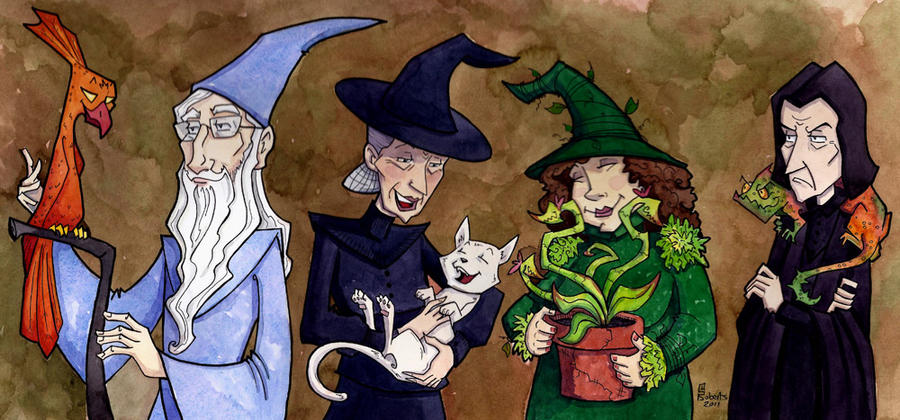
Thank you to the (real life) adults who joined us on our magical journey. Picture by CorinneRoberts at dA

Youth was a necessary prerequisite for membership in The Generation, but the adults were walking with us, just off the path. They knew how important the books were for us - these adults that were divided by Beatles and Stones or whatever the dividing lines were in the subsequent decades. My mum would always pre-order a copy of the latest book for the day it was released, then spend the entire day watching the clock as my brother and I took turns reading. It was understood and accepted by my parents that I would set my alarm for 3 a.m. to finish the book before school the next day; and there, teachers overlooked the students who slumped in their seats and could barely keep their eyes open. I was forgiven for not doing any violin practise the week the sixth book was released; in fact I didn't even open my case during the lesson, and spent 30 minutes arguing with my teacher over Snape's motives and what it could possibly mean for the final instalment. Fast forward a few years and during one particular enthusiastic discussion on critical literary theory at university, the professor didn't even raise an eyebrow when we started comparing Harry Potter to Aristotle. Talking about it in this setting felt as natural as breathing.

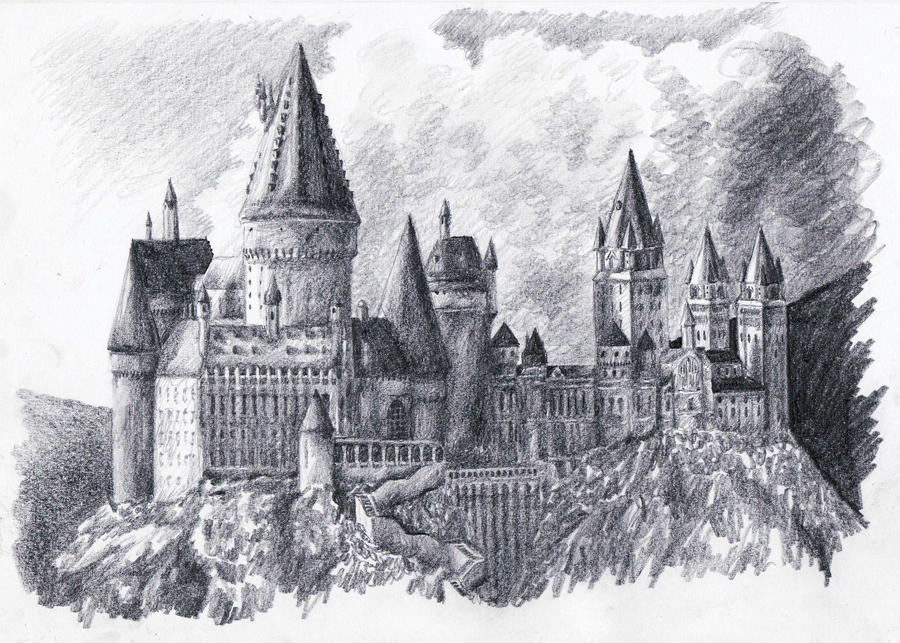
I'm sure higher education would have been even more inspiring in a castle. Hogwarts drawing by matsuo1326 at dA

So what else has become of us as we moved into adulthood? One interesting study into media consumption and politics suggested that, "Reading the [Harry Potter] books correlated with higher political tolerance, less predisposition to authoritarianism, greater support for equality, and grater [sic.] opposition to the use of violence and torture." All of these are very recognisable themes throughout the series. We are also the generation that grew up alongside the Internet and social media, with access to knowledge and news about current global political turbulence and suffering instantaneously, so to have such values instilled as we came to see all this was and is incredibly important. So, keep reading. 

Image Source
Unless you are one of the mega fans, approaching 30 it is unlikely Harry Potter still consciously features in your life much. But perhaps, occasionally, there's a piece of news from the Wizarding World that catches your eye. You smile fondly, maybe feel a tiny knot of excitement in your chest that recalls the feeling you had when you held the latest book in your hand for the first time - recalls, but could never replace.

"The stories we love best do live in us forever." said Rowling at the final premiere, and I whole heartedly agree. I carry with me so many words, places and characters that have all meant something to me and give me feelings of joy, pleasure and comfort. As I approach 30 I still dream of ginger beer on my hikes, wonder about wolves in the woods, and reach through to the backs of wardrobes, just to check. But this is the literary world I grew up with, so, for example, I wasn't too surprised when I was eating a pear a few months ago, and suddenly remembered that you can tickle a pear in a portrait of a fruit bowl to gain entry to the Hogwart's kitchens. 'Oh yeah,' I thought, and got back to whatever I was doing.

"It does not do to dwell on dreams and forget to live." said Albus Dumbledore in Philosopher's Stone. This is what we had to learn as Harry Potter weaved in and out of our childhood and teen years.** But I also think Dumbledore got it very right in the final book:

"Of course it is happening inside your head, Harry, but why on earth should that mean it is not real?"
by xXcherushiiXx at dA

End note: if this has brought up any traumatic memories from the past, Pottermore has very helpfully published 'How to deal with life when you've just finished reading Harry Potter' that may help you to work things through.

~&~

*I've not got anything against superfans. We've all been one at some point, for something. And a lot of the time superfandom is a representation of a deep emotional attachment to something important to you: that's not a bad thing. This comment is merely an observation of the seemingly more shallow side of things, which I judged based on CAPSLOCK and !!!!!!!! use.

**It occurs to me that this is the choice of inspirational quote that I put on my 'about' page. Ha! Well that just goes to show...

Monday, 16 February 2015

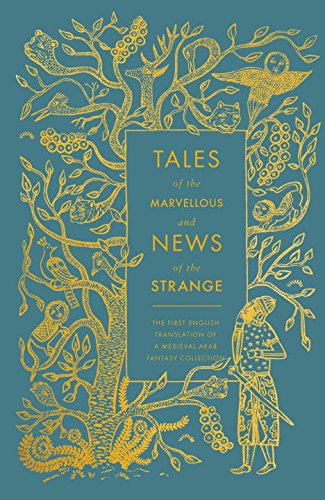
Tales of the Marvellous and News of the Strange

I'm wondering if anybody has read this book before? I came across it in an esoteric bookshop, and seeing it described as 'lost' stories that never made it into the Arabian Nights reminded me of the lost German fairytales discovered the other year. Are these stories really all surfacing at the same time...?


"On the shrouded corpse hung a tablet of green topaz with the inscription: 'I am Shaddad the Great. I conquered a thousand cities; a thousand white elephants were collected for me; I lived for a thousand years and my kingdom covered both east and west, but when death came to me nothing of all that I had gathered was of any avail. You who see me take heed: for Time is not to be trusted.'
Dating from at least a millennium ago, these are the earliest known Arabic short stories, surviving in a single, ragged manuscript in a library in Istanbul. Some found their way into The Arabian Nights but most have never been read in English before.Tales of the Marvellous and News of the Strange has monsters, lost princes, jewels beyond price, a princess turned into a gazelle, sword-wielding statues and shocking reversals of fortune."
(blurb taken from Amazon)


If anybody has read it I'd love to know what you thought! 

Tuesday, 26 August 2014

Healing our Imagination

I read Patrick Jasper Lee's observation that, as humans, we are comprised of both the factual and the imaginative, in June shortly after the episode with Richard Dawkins; so even though Lee is discussing this issue broadly with his narrow focus on shamanic journeying and the 'truth' of the experiences, I couldn't help but think about his words in relation to fairy tales and the truths we find within them...


"As already mentioned, before the dawning of the scientific age, in the last few centuries, and when it was not so important to think quite so geographically, the imagination was not considered to be such a confusing issue, but it has now been suppressed for so very long, we have completely forgotten its capabilities; our relationship with our imagination has changed because our relationship with ourselves has changed. We really have no option but to study the imagination - with a view to understanding the Otherworld - with our present understanding of science. And the Romani shamanic way can provide us with a few clever guidelines for tackling this seemingly strange idea."


"We are all affected by the creative imagination, no matter how logical we might consider ourselves to be, no matter how imaginative we might consider ourselves to be. The imagination exists, just as a fact exists. We use it unconsciously throughout much of the day. The only difference between fact and the imagination is that we do not need to prove that the imagination exists. It is actually something we can't prove and yet we can all agree that we can all choose to use it, for good or ill."

"We need now to be thinking of the health of our imagination. It is such a strong part of us that where it lies dormant we are in danger of losing much of our self-confidence and our self-belief. And that is most uncomfortable to live with."


"Generally, we need to begin questioning ourselves rather more frankly where the imagination is concerned and we certainly need to start opening our minds to the possibility of seeing the imagination as a field in its own right, worthy of considerable exploration. The imagination must no longer be thought of as ineffectual, artificial or unreal. All of the greatest scientific inventions we have in our world today began with the imagination, as did all the greatest works of art and everything we use. Even the chair you are sitting in began in someone's mind before it was brought to the drawing board!"


"We need radical changes for any revolution to take place and for some there is no doubt that the imagination will prove to be a very scary, unpredictable world at first. But we must always that it hasn't been used properly for such an extraordinarily long time that it will have to be oiled again, its creative process trusted and its existence seen as something sacred, rather than something that is just a nuisance. Without doubt, consideration of the imagination as a healing tool must feature somehow on the next rung of the ladder of human development."

Patrick Jasper Lee, We Borrow the Earth: An Intimate Portrait of the Gypsy Shamanic Tradition and Culture (London: Thorsons, 2000), 302-305.
Images from ArtMagick. Hover over images for title, artist and date.

Saturday, 9 August 2014

A Gypsy shaman's interpretation of Sleeping Beauty

We Borrow the Earth fell off a shelf in a charity shop as I reached up to replace a book next to it. The title was captivating - so I decided the book had chosen me. I knew to ignore what I'd previously heard about Gypsy culture and tradition - the stories were likely overly romanticised and mysticised accounts - and aimed to read without preconceptions as far as possible. Patrick Jasper Lee's personal experiences and thoughts about his culture and history were fascinating and written in a very engaging manner. As a practising Gypsy shaman he has a deep relationship with the Earth, and a lot of his thoughts about our ruptured relationship with our natural world resonated with me.

But I was truly delighted to find he had expressed opinions on fairy tales and their importance in our (imaginative) lives - I'm not sure how often I've read interpretations that haven't been from a Western academic perspective. Below, I've shared Lee's thoughts on Sleeping Beauty.

'La belle au bois dormant' by manu4-20-5 @ dA
"It saddens me to think just how much we have pushed the fairy-tale world underground, this beautiful magical world which once fashioned everyday life and the initiations of our deeper past in Europe. But a student of mine once said to me, 'These Romani teachings of yours reawaken the Sleeping Beauty within me.' This comment could simply sound like romantic fantasy, but it touches the very heart of the Romani shamanic journey. The lady who spoke these words was French, but this phrase also says a good deal about the spirit of the imagination which once thrived in western Europe and which is now very much like a great and beautiful princess, sleeping within us, and also beneath us within the Earth."

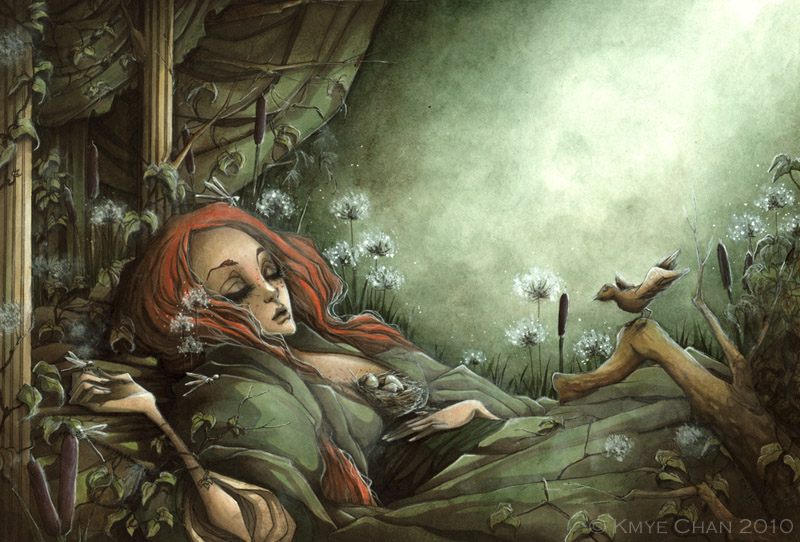
'The Sleeping Beauty' by KmyeChan @ dA
"Long ago, Sleeping Beauty, a spirit recognisable to all of us who have European roots, came under the spell of a wickedly clever fairy, whose spirit worked through many gullible sorcerers. These sorcerers threatened to kill the beautiful princess - or to take the beauty of the imagination away. The princess would prick her finger when she was 18 - civilised life would be a test for this natural spirit, nine being a crucial number for testing the soul of a great princess - and she and all her people would fall into a deep sleep in which they would know nothing of their older life, until a handsome prince found his way to the castle, kissed the princess and woke her. Then they would all live happily ever after - or reunite with their imaginative lives again. I believe we are still in that deep hypnotic slumber in our physical world, together with the beautiful Earth spirit, or princess of our land, and I believe that this seemingly eternal sleep affects us when we journey."

'Wild Nocturne' by lauraborealisis @ dA
"The Sleeping Beauty was thus a sad tale expressing the story of the Bari Weshen Dai, 'the Great Forest Mother', who was a beautiful feminine spirit residing in the forests of Europe. Her fate was sealed when the spell was cast. And she still now sleeps, entombed beneath the Earth, and also within us. Interestingly, in the French language The Sleeping Beauty is called La belle au bois dormant, 'The Beauty of the Sleeping Wood'!"

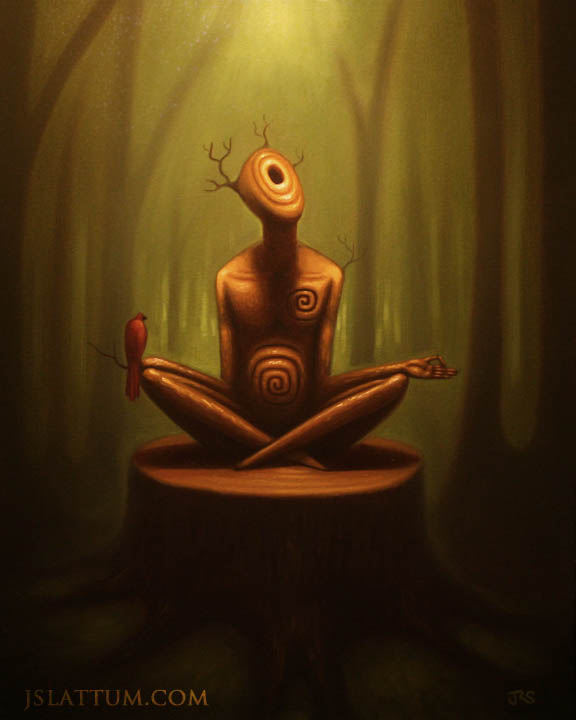
'Forest Thinking' by jslattum @ dA
"I often tell students who come to learn the craft of Romani journeying how we can take on the role of the handsome prince who kisses this beautiful lady. For a greater part of us is sleeping along with her, as we are all entranced by the spell. But when she wakes, in the future, we will wake too, and she will wake, because that is her fate also. No bad spell can last forever. The 'good' image must inevitably follow the 'bad' one! And we will eventually outwit the one who created this powerful soul-numbing slumber. Who knows what will happen when the Sleeping Beauty finally wakes!"

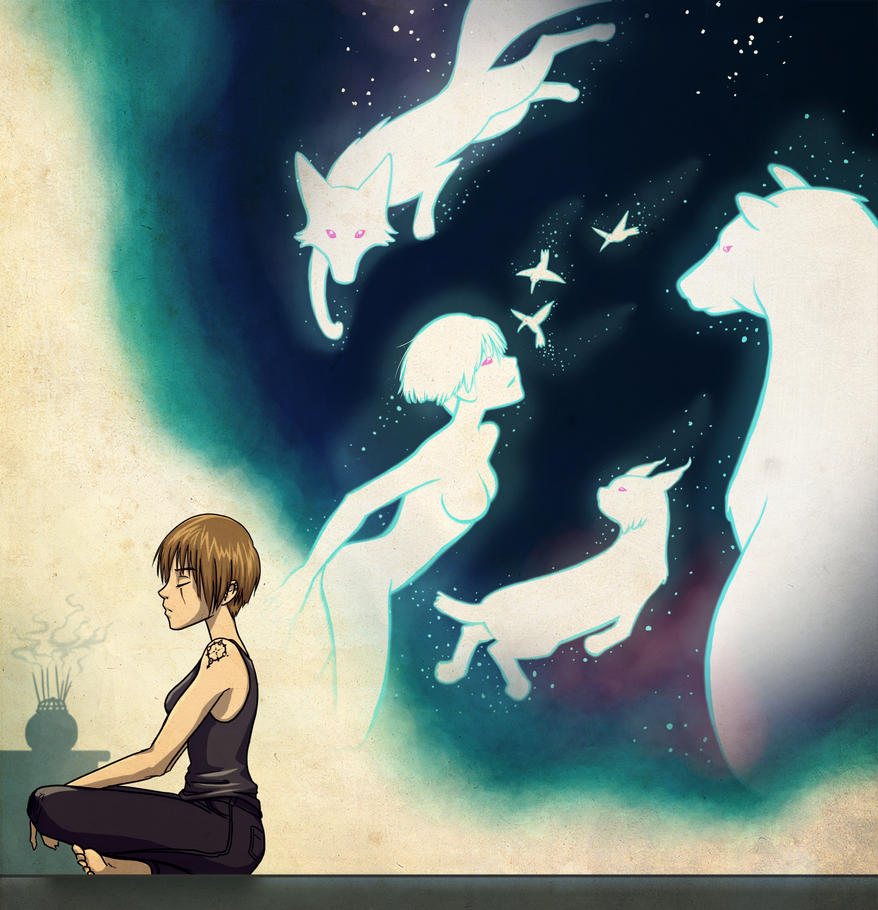
'Spiritual Journey' by Tamura @ dA
"The journey I conduct with students around the theme of waking the Sleeping Beauty is always one of the most important journeys, for it serves to rekindle the student's relationship with Puv, the Earth Spirit, via the Bari Washen Dai. It can help to develop essential assertiveness and also direction."


Patrick Jasper Lee, We Borrow the Earth: An Intimate Portrait of the Gypsy Shamanic Tradition and Culture (London: Thorsons, 2000), 222-224.

Tuesday, 21 January 2014

Le Cirque des Reves


The Night Circus
Erin Morgenstern

by viveie @ dA
A dreamer is one who can only find his way by moonlight, and his punishment is that he sees the dawn before the rest of the world.
--- Oscar Wide, 1888 (7)

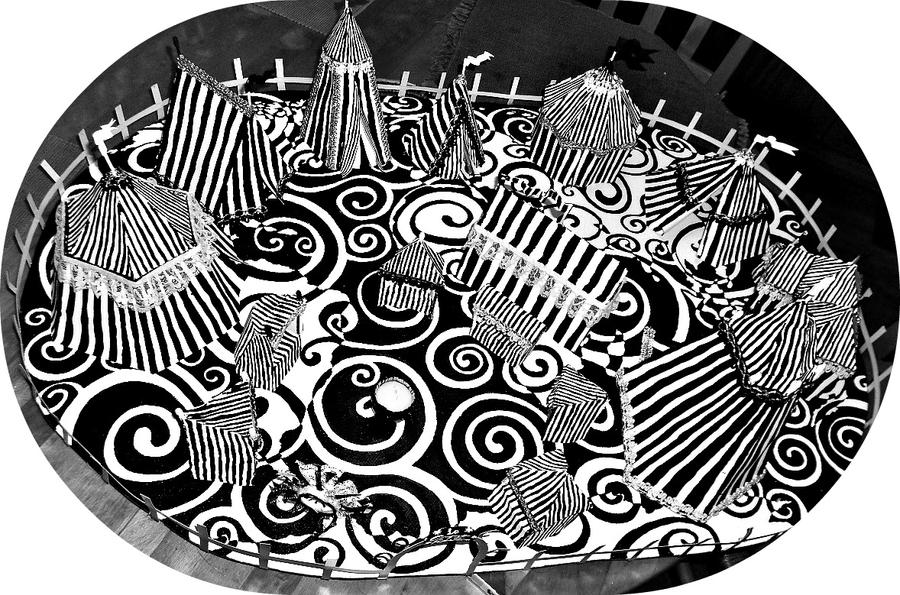
'The circus arrives without warning...' It is a surprise in every way imaginable. Le Cirque des Reves is everything we ever wanted a circus to be...perhaps it is how we saw the circus as a child. Watching the same shows is markedly different as an adult; the veil has been lifted from our eyes, the glamour has worn off. Unless, of course, we are following the swirling black and white paths of this particular circus, losing ourselves in the pathways and tents...


by beyondimpression @ dA
There is so much that glows in the circus, from flames to lanterns to stars. I have heard the expression "trick of the light" applied to sights within Le Cirque des Reves so frequently that I sometimes suspect the entirety of the circus is itself a complex illusion of illumination.
--- Friedrick Thiessen, 1894 (115)

by La-Chapeliere-Folle @ dA

There are tents containing such variety of curios and wonders that no one will be able to resist the temptation of pulling back a curtain and stepping inside. Perhaps it will be the ice garden, or maybe the mist-filled tent containing live paper animals. Will it be the cloud maze, or a tent of jars and bottles containing the scents of your fondest memories? You might visit the acrobats, the illusionist, or the fortune teller, and in between you might stand in the central courtyard and watch the cauldron of twisted wrought iron burn with a bright white flame. Don't forget to light a candle and hang it on the wishing tree. Your wish might just come true (if it hasn't already).


by Laizeck @ dA
I find I think of myself not as a writer so much as someone who provides a gateway, a tangential route for readers to reach the circus. To visit the circus again, if only in their minds, when they are unable to attend it physically. I relay it through printed words on crumpled newsprint, words that they can read again and again, returning to the circus whenever they wish, regardless of time of day or physical location. Transporting them at will.When put that way, it sounds rather like magic, doesn't it?
--- Friedrick Thiessen, 1898 (467)
by LexiARRIVING @ dA

What do you mean, 'what is the book about?'? Why does it matter? There is no good reason for me to relay the reasons this is a Romeo and Juliet story, or mention anticlimaxes or rapidly changing points of view. I am not helping if I talk in depth about the characters, the Victoriana, the magic and casual allusions to fairy tales. It is all, in the end, irrelevant. The book is not the point: it is all about the circus.


by BloodType0 @ dA

You have a particular book, I imagine; one where you like to escape to when you close your eyes after a tiring day, after it's all become too much. A world enclosed in pages that envelops you in a papery embrace and comforts you that there is still wonder in the world, beyond bills and bosses and screaming children. This is not one of those books. The Night Circus does one better. Le Cirque des Reves provides us with snippets of fantastical, mythological, magical worlds without rules and without reason (which our adult minds do so like to cling on to), tented worlds of ice, of memories, of fountains and stars and wishes. Little bubbles of wonder that allow our minds to see the circus like children again. It is what we need.

Our revels now are ended. These our actors,
As I foretold you, were all spirits, and
Are melted into air, into thin air:
And, like the baseless fabric of this vision,
The cloud-capp'd tow'rs, the gorgeous palaces,
The solemn temples, the great globe itself,
Yea, all which it inherit, shall dissolve,
And, like this insubstantial pageant faded,
Leave not a rack behind. We are such stuff
As dreams are made on; and our little life
Is rounded with a sleep.

--- Prospero, The Tempest, Act IV, Scene I (467)


*Numbers in brackets refer to page numbers in the Vintage 2012 edition of the book.

Monday, 13 January 2014

The Natural History of Unicorns

This year I have begun by ending, by finishing books I have been reading on and off over the last year. 4/5, just one more to complete! My most recent conquest definitely deserves a mention here: The Natural History of Unicorns, by Chris Lavers.

Any of you with a mythological bent will probably have seen this book pop up on your radar, and if you haven't yet checked it out I urge you to do so. Lavers takes you on a fascinating journey through thousands of years of history, mythology, misrepresentations and poor translations to demonstrate how the unicorn does and does not exist. 

He is objective with the information and at times writes with the flare of a novelist, by drawing the reader in with detailed accounts of expeditions or by adding twists and turns and bursts of new information that change the perspective of the last ten pages. As a reader this can at times make it tiring to read; the sudden changes of pace and density of information require a fair amount of effort to keep up with, and although this is the main reason it has taken me so long to finish the book, I promise you it is worth the effort. 

Lavers concludes the book by stating that it is unlikely we will ever find the original source of the unicorn myth, and I think that if we're searching for a written text, then he's probably right. He's already shown that the unicorn can end up in the Bible because translators didn't recognise a word, but made the logical assumption that a unicorn was meant based on the stories they had heard - this, to me, is a clear demonstration of the power of oral traditions and the lasting affect they can have on history, whether we're discussing the Bible or fairy stories. 

(And, on the subject of fairy tales, Lavers introduces some incredible sources of fairy tales and folklore form ancient civilisations that I personally cannot wait to look into further!)

I think the unicorn is the perfect subject for a story that begins with the age old and beloved phrase: Once there was and there was not...

Tuesday, 7 January 2014

The Art of Reading

How quickly time passes and seasons change. Yule, Christmas and New Year have flown by and I've let them pass without note. I apologise - I've never let that happen before. I've been in an introverted phase recently, feeling more comfortable in the acts of absorbing and accumulating rather than trying to express myself or attempting to create. This means I have been reading more than I allow myself to normally, which in turn makes me feel like I am coming home to myself, doing something familiar, safe, indulging and escapist.

Curious as to how others expressed the emotions and comforts of reading I had a look around deviantART, and came across this beautiful painting that I just couldn't take my eyes off:


 (click on the link above and view the enlarged version, you won't regret it!)

There is a feeling about this piece that I want to label 'eternity'. The reader doesn't seem old or young: she's as ageless as a story. The book has her full attention, and looks like it has been thumbed through many times as the pages aren't holding crisply together. She is a warm, colourful subject, and although there is light coming in from the left, there is a glow, an aura around her head like a halo as if something else is shining on her. Is it the book causing the light? Perhaps the act of reading is generating a physical force in the world...Looking at this painting is looking at an everlasting act, one that is timeless. Eternal.

I know I'm waxing lyrical and I know it's nonsense. I don't claim to know the first thing about art, but there's just something about this that makes me want to share it with you all~

I wish you all a peaceful, beautiful and blessed 2014 x

Wednesday, 27 November 2013

C.S. Lewis - 50 Years


Last week, on 22nd November, a memorial stone was dedicated to C.S. Lewis on the 50th anniversary of his death. The memorial is in the Poet's Corner of Westminster Abbey, alongside the likes of John Keats, T.S. Eliot and William Blake.


C.S. Lewis is a writer I have a very personal attachment to, beyond my deep love for his work: my Opa (grandfather) in South Africa used to send me books every birthday and Christmas, and he started sending me the Chronicles of Narnia while I was still very young. Sadly, he passed away when I was just seven years old...and the series was never completed. In fact, I didn't complete my collection for many years. I was searching for a seventh book to match the issue of the other six - it just had to have the same cover style as the others for me to feel like it was properly completed.

By the time I was 14, I had given up the search. I bought a copy of The Last Battle, not having read it before, and found that it was about death, and moving on. It couldn't have been more appropriate to finish the strange, tangled journey I had been on with this book.

So thank you, C.S. Lewis, for bringing Narnia to life. And thank you Opa for leading me to the wardrobe.


Thursday, 14 November 2013

What the Woods Want

When we close a book and put it away, how can we see how vast the world contained inside truly is?

I have a peculiar relationship with the novels of Diana Wynne Jones. I read a fair amount of them as a child, and I remember they had me hooked straight away and kept me engaged from cover to cover; they were magical, with fascinating storylines like no other, and there were a lot of surprises and twists near the end. But if you asked me, I wouldn't be able to tell you what a single one was about.

Why? I honestly have no idea (I like to think I have a pretty good book memory). So I've dug my old books out of storage and made a promise to read them all and love them again. And to remember why. I've already made a start; I've read Hexwood and wanted to share a rather beautiful sentiment from the very end of the novel.


The book doesn't sit comfortably in either the fantasy or sci-fi genre, as there is wood magic and mythical creatures as much as travel through space and time. But as the story draws to a close and the ends are tied together, the predominant setting, the woods, will not let the characters out until it has been granted a gift for all that it has been through:

'You told me the Wood can form its own theta-space and become the great Forest,' Mordion said to him. 'Does the Wood only do this when a human being enters it?' 
'I had not thought of this,' said Yam. 'Yes, I believe that when not reinforced by my field, the Wood requires human assistance to change.' 
'And not all humans will help,' Mordion said. 'I think what the Wood is trying to tell me is that it requires its own theta-space permanently, so that it can be the great Forest all the time, without having to rely on humans.'

I'm sure we've all experienced something like this, when we walk through the woods and it feels like it goes on forever, like it's the most magical place in the world and can't possibly be just a 20 minute drive from home. Diana Wynne Jones' Woods feel the same thing, and want to experience this vastness and greatness without needing a person inside to believe it into existence. 

I can imagine the same would be true of books. When we finish reading a great story we carry the world it created inside of us, whether it's the bygone England of Austen or the dystopian England of Meg Rosoff's How I Live Now, Middle Earth or Narnia, or the anyplace and anytime of fairy tales. How huge, how magnificent, and how in the world can all that be in something small enough to carry in a handbag?! 

We don't need to be inside the book, physically turning the pages to bring its world to life. There is a special relationship between book and reader that creates an everlasting world after a single union, which doesn't exist until the book has been read, and afterwards exists in both.

As I continue to re-explore my collection of Diana Wynne Jones novels, I fully intend to make sure her worlds continue to exist in me as well as the book. Let's make this magic happen!


Monday, 1 July 2013

2 Recommendations...

I am trying to get back into writing, but finding the time has been really difficult recently. I did start using an organiser though...maybe that will help?! I really hope so!

I have been forcing myself to keep reading though, because when all else fails it is reading something hauntingly beautiful, evocative and magical that will most likely get my own creative juices flowing again. I have two books I need to share with you today, because it would be wrong to keep them to myself!

The Folk Keeper 
by Franny Billingsley

Wow. How has this book not come up on my radar before? It's never been on a 'recommended' list, I've never seen it mentioned by other fairytale/folklore enthusiasts and when I have actively searched for new books to read it has never appeared...this needs to change! I can't believe I only discovered it by chance, casually browsing someone's wish list on Read It Swap It! Sorry, sorry, I'll stop ranting now...

Here's a blurb:
...Corinna Stonewall is a 15-year-old orphan who possesses a dangerous gift. She is a Folk Keeper, responsible for absorbing the attack of the savage Folk who dwell in the cellars of the Foundling Home where she lives, disguised as a boy. Through observing the correct rituals and by making careful sacrifices of choice food, she can prevent the Folk from spoiling the milk and ruining the crops. However, there are many mysteries that Corinna does not understand about herself. Where are her parents? Why does her hair grow two inches every night? Why does she long for the taste of raw fish?...Billingley's eloquent style is a joy for adults and evokes such an atmosphere of fear and longing that readers of all ages will keep turning the pages eagerly. Ages 10+ (Kirkus UK)
This book impressed me on a number of levels, one of which was simply because it involves Selkies. I haven't come across too many of them (most stories about mythical sea creatures tend to feature mermaids), and loved how they, and the other Folk, were only referred to in the vaguest sense, letting the imagination fill in the gaps and also allowing for the fact that we all know, really, on some level what Selkies and Folk are, and don't need it spelling out.

The language was intoxicating, with a rhythm and subtlety that is hard to find in books (primarily) aimed at children, but which I feel makes them all the more special - the sort of book you remember with a deeper fondness as an adult. 

I think the length is also worth mentioning: it's short. And this is very good. I think it is the perfect length for a story that is expanding on traditional folk tales, because it is able to retain 'that feeling', the one that keeps you captivated and enchanted. The longer a book gets the more complex it becomes, there are more characters, more devices, just more, and whilst I'm not in any way slating longer books that retell or recapture fairytales (seriously, I love them) I do feel that they lose something of the magic you feel from a short tale.

Highly recommended!


Wildwood 
by Colin Meloy

To begin, the blurb:
Prue McKeel is keeping out of trouble. Or trying to. Then her baby brother is abducted by crows and hauled off to the woods beyond the city. It is up to Prue to bring him back. On her mission she is plunged into the world of Wildwood and there she meets more trouble - and magic - than she ever thought possible.
This book is a gem. It's a book that did come up on my radar, and is popular enough to be in my local library, so I wouldn't be surprised if more people recognise it!

After all my posts about the forest and re-inspiring the next generation to fall in love with them, this book answers the call. I don't know whether the author suggested this intentionally or not, but the fact that the inhabitants of the town have never dared venture into the woods and are scared to go in could easily be a reflection on how out of touch we are in general with the natural world.

But when we do venture into the woods, wow, so much magic and joy; Wildwood felt like a modern version of The Lion, The Witch and The Wardrobe with amazing and diverse characters and such a cleverly woven plot. Again, this is another book with rich language and beautiful imagery that sadly seems rare in children's books nowadays - this book will not allow you to read it quickly, you have to go at a certain pace to savour the language it is so rich (I'm really not exaggerating, I tried to speed up so I didn't have to renew it with the library and felt like I was being mentally tripped up as punishment!)

I also want to quickly mention the artwork: it definitely brings to life the 'folk' element of the novel, and should be savoured as much as the words. Having pictures in children's books is not the done thing above a certain age range, but this isn't 'patronising' in the least, nor does it take away from the beauty of the words - they complement each other perfectly.
Happy reading!

Tuesday, 12 March 2013

Review: 'Mermaid' by Carolyn Turgeon

I love walking into my library and having a fairy tale retelling leap out of the stacks at me, rather than having to take a list and hunt around on the off chance that one might be stocked - this is exactly what happened to me with Mermaid. I wasn't looking for anything in particular, and there it was.

Sourced from the Author's website.
I should probably start by saying that I enjoyed reading this book. Too often the English student in me takes over my reviews with so much criticism that I read back over what I've written and wonder how I ever made it through the book in the first place! But I'm glad I've been trained to read with a critical eye. Yes, I have criticisms about this book, but that won't stop me recommending it purely on the basis that it is an enjoyable read.

Firstly, the blurb:
Two sheltered princesses, one wounded warrior; who will live happily ever after? 
Princess Margrethe has been hidden away while her kingdom is at war. One gloomy, windswept morning as she stands in a convent garden overlooking the icy sea, she witnesses a miracle: a glittering mermaid emerging from the waves, a nearly drowned man in her arms. By the time Margrethe reaches the shore, the mermaid has disappeared into the sea. As Margrethe nurses the handsome stranger back to health, she learns that not only is he a prince, he is also the son of her father’s greatest rival. Sure that the mermaid brought this man to her for a reason, Margrethe devises a plan to bring peace to her kingdom. 
Meanwhile, the mermaid princess Lenia longs to return to the human man she carried to safety. She is willing to trade her home, her voice, and even her health for legs and the chance to win his heart….

I have to admit the story is pretty predictable, and despite one slight twist on the original story (partly fuelled by the new character, Margrethe, and partly down to Lenia's actions) Andersen's classic is relatively untampered with. When I finished the book I felt cheated out of the promise that this would be a modern retelling. However, reading back over the reviews I noticed that, cleverly, the word 'modern' wasn't in fact used once, although 're-invention' and 'surprising take' were thrown around.

But then, if the original is so closely adhered to, how 'modern' can you make a story that values women differently? People talk about The Little Mermaid with affection for depicting a woman taking control of her life and pursuing her dreams...but ultimately this dream does not challenge the prevailing discourses that keep women in their proper place, as the Mermaid's desire is to become a wife. In Turgeon's retelling, the role of mother and wife is an unchallenged one; at first Margrethe seems 'modern' in that she has pursued education and takes an interest in politics (the era the book is set in marks this as unusual) but the second her position is threatened by another woman, her political motivations are forgotten amidst a delirium of jealousy, self loathing and body complexes.

Mermaid may not appeal to the feminist in me, but it does the aestheticist; there was a beauty in the imagery and at times a poetic lilt to the language, undoubtedly enhanced by the romantic settings (e.g. a convent on a stormy coastline at the edge of the world), that I would love to see more of in modern fiction.

Tuesday, 29 January 2013

When Fantasy Left the Forest

When fantasy left the forest...so did we.

'Inviting forest' by perodog @ dA
Looking at the connection between nature and happiness, and the books that get us outside...

One of the most poignant discussions for me in Gossip from the Forest was about the amount of time children are spending outdoors:
We are doing something very alarming to our children - and, making it worse perhaps, we have fooled ourselves that we are doing it for their sake, for their safety. The amount of unsupervised time outside the home that young people get to enjoy is being reduced year on year (the average child has lost a whole hour a day already this century). (1)
In 2007 Unicef published a report that stated children in the UK are the unhappiest of all the economically developed countries. Despite children themselves stating that 'having plenty to do outdoors' would make them happy, their parents felt under pressure to buy them the latest gadgets and gizmos instead (read The Guardian article on this here). The lack of connection to nature, or 'Nature Deficit Disorder', has made our country miserable. This worried David Bond so much that he set up Project Wild Thing and gave himself the title of Nature's Marketing Director, thinking that Nature needed a helping hand in getting children back outside. He created the Wild Time App, featuring a wide range of nature based activities that can be done in the time you have available, whether it's 10 minutes or 2 hours. The National Trust has also provided a list of 50 things to do before you're 11 3/4.

'Exploration' by perodog @ dA
There are numerous reasons for this deficit, but Maitland identifies a key factor: the books children read these days aren't relevant to the natural world around them.
Interestingly, we have also abandoned another genre of literature, one which encouraged children to see themselves as capable on their own in the wild. There is a sort of novel for younger readers that was immensely popular up until the last quarter of the twentieth century and that has now well-nigh disappeared: stories of adventures in which children are on their own and deal with problems under a veneer of realism; novels like Swallows and Amazons or The Famous Five... (2)
Looking at the shelves in bookshops I would not have imagined this myself; Enid Blyton seems to be a pretty permanent fixture at least. In 2010 The Famous Five publisher tried to boost sales of the series by modernising the language, although they claimed their sales weren't suffering before they took this action. Perhaps this is the problem, then: relevance to the modern world. Maybe the child is too harsh a critic to really believe it possible that parents would let their children go off alone on camping trips like Julian, Dick, George and Anne do. Suspending disbelief to make this seem credible would then make the book a fantasy tale rather than an adventure story...would it not?
We have kept the magical element of fairy stories in modern books for young people; fantasy worlds are now the location of adventures and moral combat. But we have abandoned the immensely reassuring realist element of these old tales: the forests are dangerous but you can survive; use your own intelligence and courage and you will come back safely. (3)
The wonderful thing that fairy stories create is this idea in the back of the mind that when you walk through a forest, something magical might happen to you. There are few other stories I can recall from my childhood that give me this sensation when I walk in the woods, or indeed in any other natural place.

So, do we need to bring the magic back home? Is this the challenge of the modern writer, who cares about magic, who cares about nature, and who cares about the wellbeing of children? A quick browse of the list of current children's bestsellers and upcoming releases tells me that most of the stories are fantasies or mysteries set in the city (often with supernatural creatures prowling the streets at night). I'm not surprised. Ten years ago when I was a teen, finding a new book set in the countryside felt like a rarity even then. Maybe this can be my challenge as a writer. And a challenge as a reader, to find these rare jewels - any suggestions would be most welcome, please share them with me in the comments!

'A tree of a salamander2' by perodog @ dA
Related posts:
Woods between Worlds

(1) Maitland, Sara, Gossip from the Forest, (London: Granta, 2012), 98.
(2) Ibid., 104.
(3) Ibid., 105.