Showing posts with label folklore. Show all posts

Sunday, 30 August 2015

Song of the Sea: Silence, Suffering, and Sibling Bonds

Note: I began writing about the voices of Saoirse and Ben before my computer crashed and died, and I only discovered recently that I hadn't lost all my work (hurray!) However, the film is no longer fresh in my mind and my train of thought has very much been broken, so I apologise if my thoughts do not seem so fully formed. Also, this will contain spoilers.
*--------*


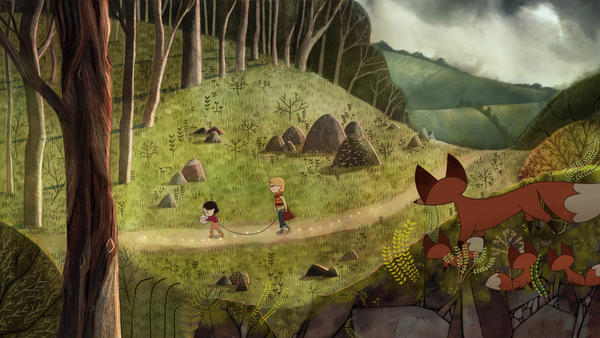
There is a lot of buzz about Song of the Sea at the moment, and rightly so: it is rich in folklore, deeply emotional and visually stunning - not that you would expect anything less from the creators of The Secret of Kells.

I will straight up admit that I am somewhat biased with my adoration of this film, because selkie tales in any form fascinate me. But Song of the Sea...it just 'got me' in that way that art grabs you sometimes. Certainly this was partly down to the distinctive artistic style, transporting us through the tale in a gentler way than the bright and flashy 3D animation we are used to these days. That haunting melody also completely captivated me. It gave me shivers.

But the film lingered with me, and made me think a lot more than most films about what it could be saying, and the wider issues it brought up for me.


One thing I was particularly interested in was the significance of Saoirse being unable to speak. Her silence is integral as a plot device because it gives Ben's human voice more importance in the world of faerie, but I'm curious about what it means symbolically too. The two relevant tales that spring to mind are Six Swans or Twelve Brothers, where a sister must not utter a word while she sews shirts made of nettle leaves in order to restore her brothers to human form; and of course The Little Mermaid, who trades her voice for legs in order to be with the man she has fallen in love with.

Both the sister in Six Swans and Andersen's Little Sea Maid are also in a state of constant pain along with their silence, the sister from handling nettle leaves and the sea maid from walking as if on knives. Although Saoirse is sick later on in the film, that particular physical suffering isn't part of the condition with the silence - I believe her pain is internal, from not knowing who she is or how to belong. She is a young girl who doesn't understand why she is different (a mythical struggle) or why her brother resents her and her father sends her away ('mundane', family struggle). Like the heroines in the other tales it is great love that spurs her on in her silent pain to overcome these challenges, and it isn't until the end when she reconciles with her mother and is able to make a decision of her own to remain with her father and brother that she begins to speak more freely.

Saoirse's freedom of choice is the big thing that differentiates her from the other two heroines, who both freely enter into magical contracts that require transitioning into their silence and pain from previous states where they enjoyed the reverse. Although these contracts have been interpreted in completely contrasting ways as signs of strength of will or symbols of female subservience, I think the lack of this initial reversal means we can overlook both of these in Saoirse's case if we choose: we can view it as growth, as a coming into the true self, and moving from a state of ignorance to knowledge of oneself and one's position in the world/family. 


Ben's voice is mistaken for the selkie's

Saoirse's silence allows the siblings to embark on the adventure together on a more even ground: she is a mythical creature who cannot speak and doesn't know the songs and stories she is expected to know, while Ben is a mundane creature with the faerie knowledge his sister requires. They are yin and yang, opposites that combine in a perfect whole.

His knowledge is also what keeps him safe. Selkie mother notwithstanding, Ben is a human child and would not under normal circumstances have such 'safe' access to the world of faerie, because, as well we know, fairies are dangerous and fickle creatures and an encounter with them can be deadly.


Anybody with a brother will have this family photo!

The human story of family ties and tragedy intertwines beautifully with the traditional folkloric elements, and you don't need to be an expert in Irish folklore to understand that. Selkie and water spirit tales often involve tragedy and heartbreak, and looking at Ben, I wonder if selkies are able to better connect on an emotional level rather than a purely imaginative level with children today in comparison to your classic wolves, witches and fairies. 


Ben's voice seems to be the voice of folklore in modern times, recalling the stories nostalgically at the same time as they breathe life into a new story, and a new moment of existence. His voice speaks for Saoirse, for the memory of his mother, but it is also our voice and the subtle reminder that we are constantly in dialogue with these tales, weaving them into our modern existence one way or another.

Tuesday, 17 March 2015

Growing Wonder

I am delighted to see that Unsettling Wonder are publishing all three issues of Volume 1 together. This incorporates 'Wonder Voyages', 'Wise Fools' and 'Fairy Brides', which contains my short story, The Grey Queen's Gown. Each issue contains an enchanting collection of fiction, essays and art and is a captivating read for anybody keen on exploring the magical worlds of folklore and fairy tales. 

It will also whet your appetite for the forthcoming issues in Volume 2: 'Why Would Anyone Enchant That?' and 'Changelings'.  

Tuesday, 2 September 2014

Discovering British Folk Art

I'll start off with some honesty: although I do occasionally go out to look at art, I'm not much of a gallery person. That's not to say I don't value and appreciate art, but at best I find galleries too much to take in, and at worst a nesting ground for pretentious sorts who are somehow able to interpret an artist's socio-political viewpoint from a particular brushstroke (and will scowl down their noses at you if your view is 'I like the colours in this one').

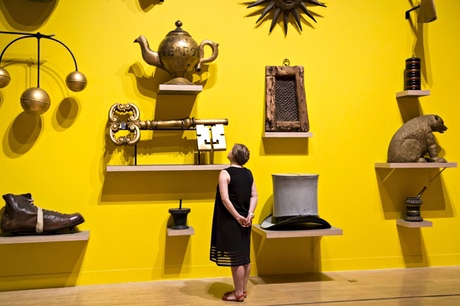
So despite being excited about the British Folk Art exhibition I was slightly wary going in. But I needn't have worried - none of my fears were realised. A subject as vast and varied as 'folk art' could have filled endless rooms and corridors, but Tate had about four rooms with themed selections that not only made it manageable, but interesting too. Of course there were some proper art buffs milling around, but their mutterings weren't audible over the hums of conversation between all the other diverse groups of people in there. What particularly stood out for me in this respect was seeing children genuinely engaged with the pieces. Your experiences may differ from mine, but for the most part when I've passed children in galleries or museums I've usually caught a 'this is so boring' or 'can we go home now?', not 'look, this is so cool!' which I heard a young boy say to his mum about the giant keys and boots used as shop signs.

Wall of trade signs (from The Guardian)
The exhibition was hailed as a celebration of objects made outside the British mainstream over the last few hundred years, and was the first of its kind. 'At its foundation in 1768-9, the Royal Academy declared that "no needlework, artificial flowers, cut paper, shell work, or any such baubles should be admitted" to its prestigious exhibitions...' and examples of all of these, and much more, were featured.

Like I said, I don't know much about art; this is merely a few paragraphs about the things I found most interesting or beautiful, and I hope that many more of you have the chance to see the exhibition as it leaves the Tate and travels onward.

Two variations of 'The Earthstopper' by George Smart
George Smart (c.1775 - 1846) was a tailor in Tunbridge Wells who made collages out of textile and paper scraps. Smart reproduced his pictures to sell, resulting in many variations of his work. The exhibition featured different versions of 'Goosewoman', 'Old Bright the Postman', and 'The Earthstopper'.

Two walls were dedicated to the sea, the sky and land - common themes in folk art. They featured lots of wool-on-canvas work such as embroidered maps of the country, counties and solar system - even the layouts of farms. There were also several ships and seascapes usually made by retired sailers and fishermen, like John Craske (1811-1943), 'a Norfolk fisherman who took up painting and embroidery when he was forced to retire due to ill health'. On display was his woolwork 'Rescue', an embroidered image of a boat being rescued off the coast. The Royal Academy's rejection of 'feminine arts' included needlework, so it hadn't even crossed my mind that there would be male artists working with silks. And I wonder how many do now.

Within this area, one piece in particular stood out for me: the 1811 wool and silk solar system, created by a girl as part of her education. It included a quote from Milton's 'Paradise Lost' at the top, and depicted the orbit of a comet and the known planets of the solar system, including their distance from the Sun. At the time, Uranus was called 'Georgium Sidus' after the King. I wonder if I would have enjoyed certain subjects more when I was at school if I'd had the opportunity to learn them creatively - felted trigonometry, perhaps?


This Sweetheart Pincushion, made in 1896, would have been sent home by a soldier/sailer to a loved one, probably during the Crimean War. If you'd told me before that a pin cushion would blow my mind I would have laughed at you. But, wow, pins are fascinating! Back then pins were handmade and very expensive; so expensive in fact that they were only sold two days a year, as people would need the rest of the year to save up to buy them! And the folklore of pins was spectacular too: sticking a pin into a textile was said to bring luck to the person it was for; on ships, sailers associated pins with witches and called them 'little witches in disguise', yet they would still bring them on board as good luck charms to neutralise a witch.


The Harvest Jug, made in 1838 in North Devon from Red Earthenware with a yellow slip, has 'sgraffito' (scratched) decorations referring back to earlier traditions (and I'm pretty sure that's where we get the word 'graffiti' from). It depicts the Sun, a cockerel, flowers and leaves, and the text on the side is a poem exalting harvest labourers. The jug was made for harvest celebrations, and would have been a treasured possession within the family. I can't say exactly why I was so drawn to this. Perhaps it was the colours, maybe the mishmash of text and art, or just the fact that it is beautiful and practical - art with a function within the family.

One particularly mysterious piece was the God-in-a-bottle or 'whimsy', 'patience' or 'puzzle' bottle. From the late nineteenth century, they were associated with the Roman Catholic diaspora, especially labourers in northern England. Their purpose remains a complete mystery.

Gods in bottles (from New Statesman)
The oldest object on display was a wooden nutcracker c.1595-1605. It was carved like a person, and the nut would have been cracked in his mouth. On the theme of food, there was also a wooden gingerbread mould in the form of an alphabet square c.1600-1750.

There was a room full of carved figures for ships or trade signs. They were great...but I wouldn't have liked to have been alone in there. There was something creepy about them, especially the more garish ones. For me they fall into the same creepy category as clowns and china dolls, you know? Anyway, the garish ones had been more recently restored, and I discovered that a feature of much folk art is the repainting or remaking by many hands over time (does this count with folklore as well, and the way we rewrite and rework traditional stories?)

Mary Linwood's 'needlepainted' self portrait after John Russell (from The Foundery)
Mary Linwood (1755-1845) created an amazing needlework self portrait based on a pastel portrait done of her as a young woman. Linwood's art is called 'needlepainting' because it is so intricate, and her fame is based on embroidered copies of Old Masters such as Rembrandt. She was excluded from the Royal Academy as they would not accept needlework or other 'feminine arts', but as well as that, 'she remains largely unclassifiable, lacking the originality demanded of the fine artist, and the 'authenticity' required of the folk artist, yet also disconnected from domestic craft traditions.'

All these questions surrounding classification, intention and authenticity must have made it a real headache trying to put this exhibition together!


The final picture I took was of the felted wool Crimean Quilt (c.1853-6), which was '...created by soldiers injured in the Crimean War. It comprises over 10,000 separate pieces; the creation of such labour-intensive textiles was promoted among serviceman as a form of therapy.' Creating something like this would have helped to keep servicemen away from drink, gambling and women, and would have been a great help dealing with the effects of Post Traumatic Stress Disorder. It includes parts of soldier's uniforms; there is one myth that says it contains the uniforms of lost comrades as a memorial to them.

The final room examined folk art as an expression of community and collective identity, and the idea of the folk artist as a 'wholly idiosyncratic maker' e.g. Jack Punter and 'The House that Jack Built'. We were reminded that folk art and folk traditions are not part of some long-forgotten past, but are still alive today in the form of pearly kings and queens, mummers, master thatchers and straw effigies, well dressings and so on...

Exhibition room (from June Sees. Check out their review and more pics here)
If you can catch the exhibition at its next stop, please do! And here is a review from The Guardian.

Monday, 26 May 2014

British Folk Art exhibition @ Tate Britain

British Folk Art, 10 June - 31 August (Link)

A wonderful new exhibition is starting soon at Tate Britain in London - I can't wait! Alongside the exhibition there is also a whole host of courses, workshops and talks on folk art throughout June and July, which include collage, embroidery and knife-carving.

Goose Woman by George Smart c1840

From The Tate website:
Steeped in tradition and often created by self-taught artists and artisans, the often humble but always remarkable objects in this exhibition include everything from ships’ figureheads to quirky shop signs, Toby jugs to elaborately crafted quilts.
You will find an intricate sculpture of a cockerel, made out of mutton bones by French POWs during the Napoleonic wars. There is a larger-than-life-size figure of King Alfred made out of thatch. There are examples of the mysterious ‘god in a bottle’ – votive offerings suspended in bottles of clear liquid – as well as naïve paintings, tin trays covered with ornate fragments of crockery and much more besides. The show exemplifies the energy, variety and idiosyncracy of British Folk Art.
Folk art has often been neglected in the story of British art: by uncovering this treasure trove of folk art objects, this exhibition asks why.

Monday, 1 July 2013

2 Recommendations...

I am trying to get back into writing, but finding the time has been really difficult recently. I did start using an organiser though...maybe that will help?! I really hope so!

I have been forcing myself to keep reading though, because when all else fails it is reading something hauntingly beautiful, evocative and magical that will most likely get my own creative juices flowing again. I have two books I need to share with you today, because it would be wrong to keep them to myself!

The Folk Keeper 
by Franny Billingsley

Wow. How has this book not come up on my radar before? It's never been on a 'recommended' list, I've never seen it mentioned by other fairytale/folklore enthusiasts and when I have actively searched for new books to read it has never appeared...this needs to change! I can't believe I only discovered it by chance, casually browsing someone's wish list on Read It Swap It! Sorry, sorry, I'll stop ranting now...

Here's a blurb:
...Corinna Stonewall is a 15-year-old orphan who possesses a dangerous gift. She is a Folk Keeper, responsible for absorbing the attack of the savage Folk who dwell in the cellars of the Foundling Home where she lives, disguised as a boy. Through observing the correct rituals and by making careful sacrifices of choice food, she can prevent the Folk from spoiling the milk and ruining the crops. However, there are many mysteries that Corinna does not understand about herself. Where are her parents? Why does her hair grow two inches every night? Why does she long for the taste of raw fish?...Billingley's eloquent style is a joy for adults and evokes such an atmosphere of fear and longing that readers of all ages will keep turning the pages eagerly. Ages 10+ (Kirkus UK)
This book impressed me on a number of levels, one of which was simply because it involves Selkies. I haven't come across too many of them (most stories about mythical sea creatures tend to feature mermaids), and loved how they, and the other Folk, were only referred to in the vaguest sense, letting the imagination fill in the gaps and also allowing for the fact that we all know, really, on some level what Selkies and Folk are, and don't need it spelling out.

The language was intoxicating, with a rhythm and subtlety that is hard to find in books (primarily) aimed at children, but which I feel makes them all the more special - the sort of book you remember with a deeper fondness as an adult. 

I think the length is also worth mentioning: it's short. And this is very good. I think it is the perfect length for a story that is expanding on traditional folk tales, because it is able to retain 'that feeling', the one that keeps you captivated and enchanted. The longer a book gets the more complex it becomes, there are more characters, more devices, just more, and whilst I'm not in any way slating longer books that retell or recapture fairytales (seriously, I love them) I do feel that they lose something of the magic you feel from a short tale.

Highly recommended!


Wildwood 
by Colin Meloy

To begin, the blurb:
Prue McKeel is keeping out of trouble. Or trying to. Then her baby brother is abducted by crows and hauled off to the woods beyond the city. It is up to Prue to bring him back. On her mission she is plunged into the world of Wildwood and there she meets more trouble - and magic - than she ever thought possible.
This book is a gem. It's a book that did come up on my radar, and is popular enough to be in my local library, so I wouldn't be surprised if more people recognise it!

After all my posts about the forest and re-inspiring the next generation to fall in love with them, this book answers the call. I don't know whether the author suggested this intentionally or not, but the fact that the inhabitants of the town have never dared venture into the woods and are scared to go in could easily be a reflection on how out of touch we are in general with the natural world.

But when we do venture into the woods, wow, so much magic and joy; Wildwood felt like a modern version of The Lion, The Witch and The Wardrobe with amazing and diverse characters and such a cleverly woven plot. Again, this is another book with rich language and beautiful imagery that sadly seems rare in children's books nowadays - this book will not allow you to read it quickly, you have to go at a certain pace to savour the language it is so rich (I'm really not exaggerating, I tried to speed up so I didn't have to renew it with the library and felt like I was being mentally tripped up as punishment!)

I also want to quickly mention the artwork: it definitely brings to life the 'folk' element of the novel, and should be savoured as much as the words. Having pictures in children's books is not the done thing above a certain age range, but this isn't 'patronising' in the least, nor does it take away from the beauty of the words - they complement each other perfectly.

Happy reading!

Saturday, 16 February 2013

The Folk Heritage of Fantasia

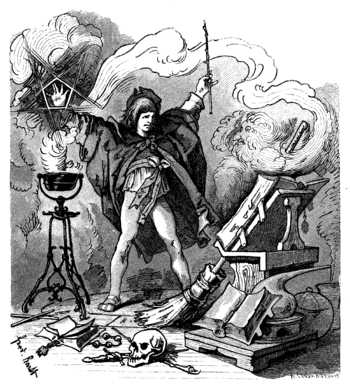
I'm sure we've all watched and enjoyed Fantasia at some point, haven't we? The star of the show, without a doubt, is Disney's own Mickey Mouse in The Sorcerer's Apprentice, based on a poem by the famous German writer Goethe.

It is the story of a foolish young apprentice who decides to mess around with his master's book of magic, and ends up getting himself into danger; luckily his master arrives in the nick of time and is able to save him from drowning.

Source
I was rather surprised to come across this story as part of Joseph Jacob's collection of English Fairy Tales, under the heading The Master and His Pupil. It is the same basic story, except that instead of the apprentice enchanting a broom, he accidentally summons the Devil and has to set him tasks to avoid being strangled. In a panic, the apprentice tells the Devil to water a flower, but he keeps bringing barrel after barrel of water into the home and flooding the house. Just when the water level is about to rise above the apprentice's chin, the master comes home and sends the Devil back where he came from.

Jacobs published his collection in 1890 and states that his source is an 1866 collection of traditional folk tales from the Northern counties of England (Yorkshire is named in the text). Goethe's poem was published a hundred years earlier. It will never cease to amaze me how far through space and time these stories have travelled.


Monday, 10 December 2012

There's something wrong with Gwen...

Angel Coulby as Guinevere in BBC's 'Merlin'
Readers, as you'll have noticed by now, I love my legends of King Arthur. I moaned about 'Camelot' as I re-discovered and enjoyed 'Merlin', and I couldn't believe it when I found out Caerleon was IS Camelot. Apologies to the readers who follow for fairy tale or writing related ramblings, but this is a 'Merlin'-related rant (that may contain spoilers, so be warned!) about feminism and the depiction of women on TV.

So...anyone noticed that something is wrong with Gwen? I don't mean the way she was brainwashed by Morgana, I mean before that. And after that. The girl who was so active, so passionate, and so kind to everyone in the previous series has become passive and distant now that she has married. I used to think it was very cool to show a woman who deserved to become queen, who lived her life like a queen even though she was a servant. But now...Gwen has become Arthur's accessory.

She sits meekly at Arthur's side and does nothing. She doesn't talk kindly (at all, really) to Merlin, even though they were friends. And she has lost her passion and compassion (I'm thinking about how she obediently 'performed her duty' of sentencing a young girl to be executed. She tried to alleviate her conscience by taking a chance on the fact that the girl's father would show up and try to rescue her, which is a far cry from actually standing up for what she believed in, which is that the girl was innocent.)

Katie McGrath as Morgana
Strangely enough, when Morgana brainwashed her in that dark tower, Gwen became more like the person she used to be. She began to sneak around, actively trying to accomplish what she believed in. She acknowledged her roots, the fact that she came from a 'normal' background. She took the time to relate to Morgana and feel her pain, wanting to bring her justice, unlike the girl she sentenced to be executed, whose pain she wanted to ignore and whose fate she wanted to leave to chance.

Of course, Merlin and Arthur saved the day and 'cured' Gwen. She went back to being the docile, passive woman they had grown accustomed to. Unsurprisingly, that was the end of Gwen as a prominent part of the storyline. And did anything come of it? Well...she did say 'thank you' to Merlin, I suppose.

I feel this brings up the familiar discussions about women giving up their lives when they become married, and of the women in stories who are dangerous purely because they have agency. But what really makes me cross this time is that the BBC has shamelessly and clearly shown Gwen change from strong to weak, active to passive, admirable to deplorable. This is a children's show, it has a 19:30 time slot, and the ONLY female character who represents the force for good is sitting around looking pretty. So much for the role model.


Sunday, 21 October 2012

Why the newest fairy tale magazine might reignite Britain's folk heritage

...Unsettling Wonder was officially launched at the beginning of the month - click the logo to explore the website!


If you follow any of the blogs I link to on my sidebar, then chances are this won't be news for you! But in case you missed the deluge of blog posts last week, here is a bit of information from the website:

Unsettling Wonder is about going back to...that troubling, entrancing glimpse into story. Childhood affords us the first glimpse, but it is by no means the last. And the oldest stories—the fairy tales we met in childhood, the folklore and folk traditions that gave rise to them—can still be woven together for telling today. We want embrace [sic] and celebrate, re-imagine and re-invent, our folk traditions, the wild and variegated scrapheap of story and theme and motif that lies open to the magpie gaze of the writer.

But why do I think Unsettling Wonder could 'reignite Britain's folk heritage'? 

After having a look around the site I was struck by a couple of things: firstly, of the five members of staff listed, four of them have strong links to Britain, particularly to Scotland. Secondly, in the 'about' section of the website, which provides a type of mission statement for the magazine, we can read that the magazine wants to tell the tales of 'Woods and princes, elves and fools, voyages and rolling cheeses, tricksters and righteous sages, kings dressed as beggars, stories told by thieves.' Rolling cheeses? Now, that's not something I've ever seen mentioned specifically before by a fairy tale magazine! Cheese rolling is an ancient - and possibly pagan - British tradition that is still celebrated today in the Cotswolds. Correct me if I'm wrong, but I have never heard of such an event happening elsewhere in the world.

Does the British folk and fairy tale need a renaissance?

Maybe. Maybe not. I think when most people think of the British fairy tale, chances are they'll be thinking of the works of Victorian writers who, for all their moralising, produced great works and great names that stay with us: Andrew Lang, Charles Kingsley, Christina Rossetti...What I personally love is the slightly blurred boundaries between folk tales and fairy tales that occur: Victorians wrote moral versions of familiar fairy tales, but also incorporated that moral tone into stories of fairies, sprites and all the other mischievous little folk whose legends litter our countryside. Kingsley's The Water-Babies is an example of this, yet it is still called a fairy tale.

And things seem to have been a bit quiet since then (although perhaps the passing of time will make it easier to see otherwise...) Fantasy is something that Britain has always done well, in short stories and novels, but I'm not aware of any rejuvenated fairy tales that have had much impact. American writers seem particularly good at producing the 'modern' fairy tale set in, say, a desert or a high school. But I haven't seen many British writers take the fairy tale in that direction - perhaps we are struggling to move on from the unique blend the Victorians produced for us? A lot of fairy tale magazines/ezines seem to be based in America and have American editors too.

I don't know. I'm just speculating, and I won't pretend I've spent hours and hours researching this - I am basing this purely on my own observations (so criticise me, agree with me, attack me - lets debate this!) But perhaps Unsettling Wonder will allow British writers to shake off the dust covering their tomes of folk and fairy tales, and re-explore a land left behind long ago, creating new footprints in the dust...

Wednesday, 19 September 2012

Sussex Centre for Folklore, Fairy Tale and Fantasy

If you live in the south of England you may be aware of the Sussex Centre for Folklore, Fairy Tale and Fantasy, based at the University of Chichester. They frequently hold events that will interest any fairy tale fans out there, and this is the latest one:

Sex, lies and Videotape: The brothers Grimm experience
Wednesday 10 October 2012 5.15pm-6:30pm, Cloisters, Bishop Otter Campus,University of Chichester**Professional story-teller Janet Dowling presents the story of how the brothers Grimm cleaned up their act for contemporary readers … and what Disney did next
.
Their advisory board is made up of big names in the global business of fairy tales, including Jack Zipes, Maria Tatar and Marina Warner. There are a couple of videos of lectures on the site, and a link to buy their journal, Gramarye.

It has occurred to me that I am only about 1 hour and a £13 train fare away from Chichester, and that I should definitely make use of such a wonderful centre that is practically on my doorstep!

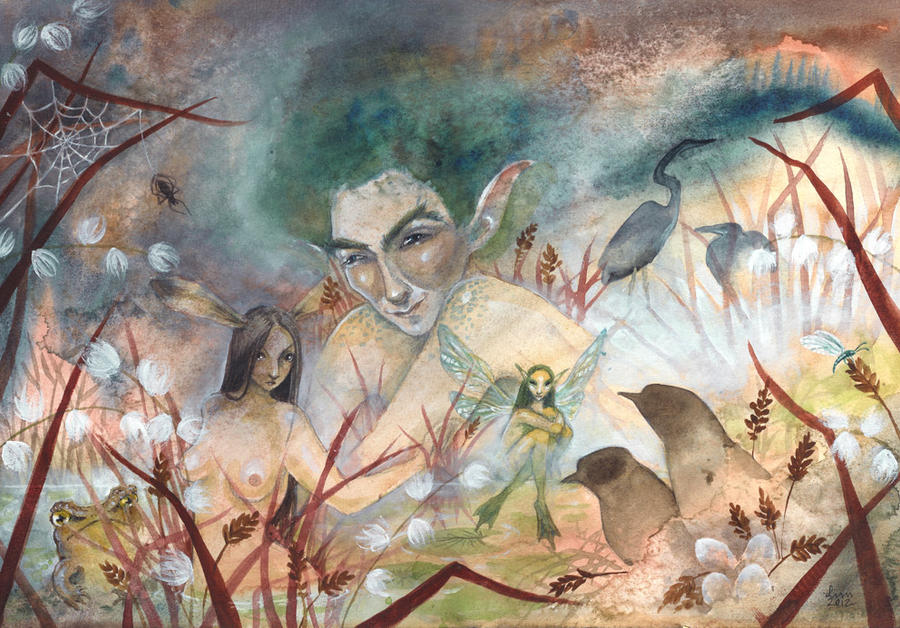
Marshland by liselotte-eriksson @ dA

Friday, 13 July 2012

Old Oak & The Maiden

After my last post, it seems an appropriate time to say that I have written a 'new' fairy tale! The driving force behind it was the question, 'what would happen if someone in need refused to accept magical help?' After discovering a piece of artwork that so brilliantly illustrated my story (which I blogged about here) I decided that I had no excuse for not finishing it!


I have no doubt that people will be able to see some of the stories that have inspired me, including older versions of Cinderella, the legends of King Arthur, The Tinder-Box...the list could go on. It's a mish-mash of traditions, but hey, there's nothing wrong with that, right?


Old Oak & The Maiden is currently being considered for submission, but I believe I can post an extract without it causing any harm:
     At the very heart of the forest, where no stars could be seen through the treetops, where no animals dwelled and where silence was as thick as honey, she stopped. She had arrived before an ancient oak tree, and mustering the final dregs of her energy she curtseyed in front of the thick, gnarled bark, before collapsing onto the floor and relinquishing into sobs. She had shed the last of her grace.
     Time expanded and contracted, and moved in the mysterious patterns called forth by solitude. She didn't know how long she stayed curled up amongst the dead leaves and her dirty dress, but enough time had elapsed for her to fall quiet once more. 
     The tree spoke to her at last.
     'Fair maiden, you did not come all this way to simply cry at my roots. Tell me your troubles.'
Inspiration from nature: Friston Forest, October 2011 

Wednesday, 4 January 2012

Is Caerleon the real Camelot?

'Camelot' by bikerblue61 @ da
When I was growing up my parents used to take us to stay with a family friend who lived in Caerleon, in south Wales. It was a place that, to this day, I associate with an element of magic and mystery, which I probably sensed from the Roman remains, which included an impressive amphitheatre. Some of my strongest memories from that place are of trudging amongst the ruins, and drinking cranberry juice in the garden of The Hanbury Arms (I used to think it was funny that 'cranberry' sounds like 'Hanbury'...)

But the other day I discovered that Geoffrey of Monmouth, who wrote the fantastically inaccurate Historia Regum Britanniae, believed that Caerleon, an important town to the Romans...was also the court of King Arthur. Although I haven't read it for myself, (yet) apparently Thomas Malory even has Arthur crowned at 'Carlion' in his retelling of the legend, Le Morte D'Arthur. 

And, even more exciting for the girl who once sat there and drank cranberry juice, Alfred Lord Tennyson actually stayed at The Hanbury Arms while he was writing The Idylls of the King! 

Why are so many people flooding to Glastonbury Tor in search of Avalon when they could go to Caerleon for Camelot?!

Unsurprisingly, this has re-ignited the flame that I burn out of love for Arthurian legend! If anyone would like to recommend any Arthurian literature, TV, artwork, anything, then please leave me a comment with your suggestions!

And, if you're interested, you can read my earlier review/discussion of the TV show Camelot and thoughts on keeping Arthurian legends alive...

Sunday, 25 December 2011

Merry Christmas

Merry Christmas everybody! I hope that wherever you are, whoever you're with, and whatever you have planned...I hope you have a fun, relaxing and indulgent day~ x


If you want to read some Christmas themed folk tales to further engulf you in the spirit of today's festivities, you can do so here :)


Wednesday, 15 June 2011

More King Arthur TV


Did anyone watch 'Camelot' on Saturday night? What did you think?

picture from here
I'm in love with old folk tales and fairy stories from all over the world; I think there's something really special about the way they have enchanted so many generations, and continue to do so. There's no denying that modern media has helped spread the magic to new audiences in an 'age of images' rather than words, but although they can do them justice...sometimes they just let you down. And sure, they're targeting different audiences, but with stories that have so much history and are so popular there's definitely high expectations that they ought to live up to.

And something really just bugged me about Camelot...

I'm not entirely sure whether I liked it. I suppose I was automatically comparing it with BBC's 'Merlin', which I dismissed pretty much straight away because in my view it was trying to fill the gap left by 'Robin Hood' (which I loved) and for me, at the time, it couldn't. So I thought 'hey, Camelot has to be better than that!'

The ads made me think it was going to be more gritty and realistic (kudos, they had people going at it in the hall with the King there) but then Jamie Whatshisface popped up as Arthur...it kind of went downhill from there for me. He seemed very preppy and pampered and it was a bit surreal next to Merlin and Morgan's intensity. And it felt weird trying to laugh about it because the show seemed to take itself too seriously.

Which got me thinking about Merlin again, and I wondered if I would dismiss it so easily now. I watched the first episode again and what eluded me a few years ago when it first came out suddenly clicked: its just a bit of lighthearted entertainment, no pretensions. It made me smile and laugh and feel enchanted (which is the point of these stories!) Yes, it had a 6:30pm time slot rather than 9:00pm like Camelot, so they are aimed at different age groups, but based on first episodes I found myself enjoying Merlin more...I just spent an hour and a half feeling a bit uncomfortable and confused on Saturday night, which...isn't really my idea of fun.

But these re-tellings and re-workings will never be able to please everybody, will they? 

Funnily enough the only modern Arthur TV programme that I really loved was the storyline that ran through the BBC series 'Bonekickers' which was about a group of archaeologists, one of which was obsessed with Excalibur. If you haven't seen it I highly recommend you seek it out!

And if anyone can recommend some good programmes/films based on folk/fairy tales - I'm a sucker for them, so let me know!