Saturday, 9 August 2014

A Gypsy shaman's interpretation of Sleeping Beauty

We Borrow the Earth fell off a shelf in a charity shop as I reached up to replace a book next to it. The title was captivating - so I decided the book had chosen me. I knew to ignore what I'd previously heard about Gypsy culture and tradition - the stories were likely overly romanticised and mysticised accounts - and aimed to read without preconceptions as far as possible. Patrick Jasper Lee's personal experiences and thoughts about his culture and history were fascinating and written in a very engaging manner. As a practising Gypsy shaman he has a deep relationship with the Earth, and a lot of his thoughts about our ruptured relationship with our natural world resonated with me.

But I was truly delighted to find he had expressed opinions on fairy tales and their importance in our (imaginative) lives - I'm not sure how often I've read interpretations that haven't been from a Western academic perspective. Below, I've shared Lee's thoughts on Sleeping Beauty.

'La belle au bois dormant' by manu4-20-5 @ dA
"It saddens me to think just how much we have pushed the fairy-tale world underground, this beautiful magical world which once fashioned everyday life and the initiations of our deeper past in Europe. But a student of mine once said to me, 'These Romani teachings of yours reawaken the Sleeping Beauty within me.' This comment could simply sound like romantic fantasy, but it touches the very heart of the Romani shamanic journey. The lady who spoke these words was French, but this phrase also says a good deal about the spirit of the imagination which once thrived in western Europe and which is now very much like a great and beautiful princess, sleeping within us, and also beneath us within the Earth."

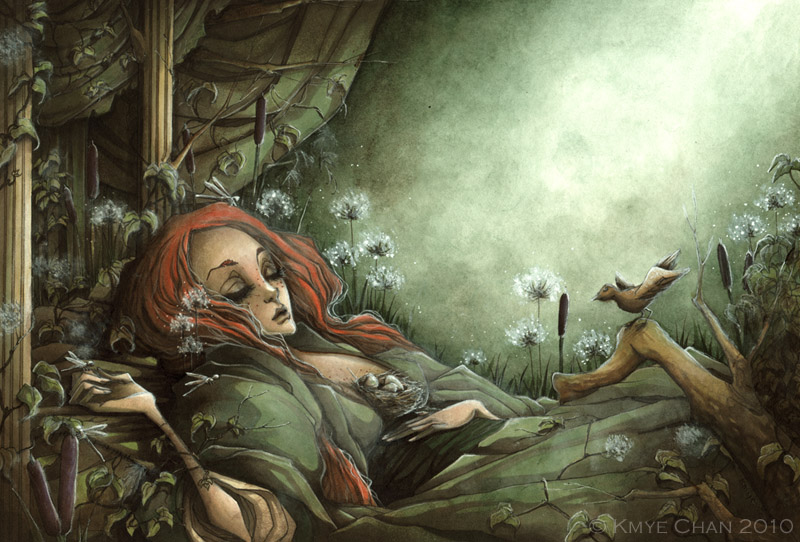
'The Sleeping Beauty' by KmyeChan @ dA
"Long ago, Sleeping Beauty, a spirit recognisable to all of us who have European roots, came under the spell of a wickedly clever fairy, whose spirit worked through many gullible sorcerers. These sorcerers threatened to kill the beautiful princess - or to take the beauty of the imagination away. The princess would prick her finger when she was 18 - civilised life would be a test for this natural spirit, nine being a crucial number for testing the soul of a great princess - and she and all her people would fall into a deep sleep in which they would know nothing of their older life, until a handsome prince found his way to the castle, kissed the princess and woke her. Then they would all live happily ever after - or reunite with their imaginative lives again. I believe we are still in that deep hypnotic slumber in our physical world, together with the beautiful Earth spirit, or princess of our land, and I believe that this seemingly eternal sleep affects us when we journey."

'Wild Nocturne' by lauraborealisis @ dA
"The Sleeping Beauty was thus a sad tale expressing the story of the Bari Weshen Dai, 'the Great Forest Mother', who was a beautiful feminine spirit residing in the forests of Europe. Her fate was sealed when the spell was cast. And she still now sleeps, entombed beneath the Earth, and also within us. Interestingly, in the French language The Sleeping Beauty is called La belle au bois dormant, 'The Beauty of the Sleeping Wood'!"

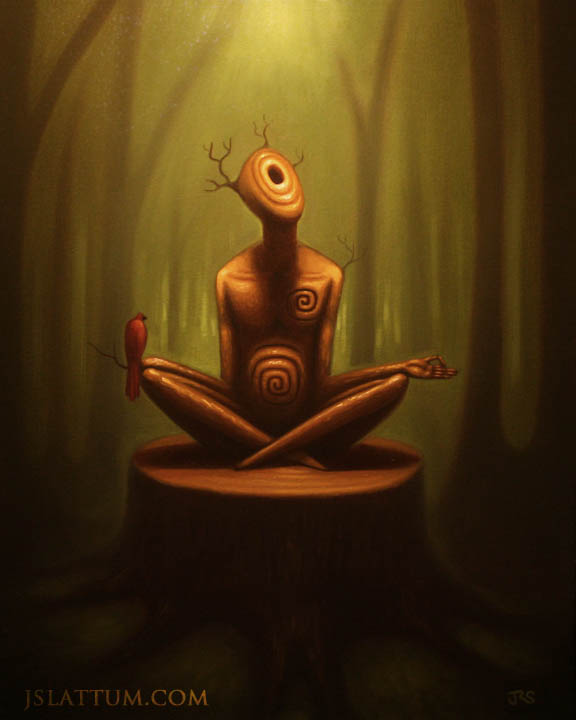
'Forest Thinking' by jslattum @ dA
"I often tell students who come to learn the craft of Romani journeying how we can take on the role of the handsome prince who kisses this beautiful lady. For a greater part of us is sleeping along with her, as we are all entranced by the spell. But when she wakes, in the future, we will wake too, and she will wake, because that is her fate also. No bad spell can last forever. The 'good' image must inevitably follow the 'bad' one! And we will eventually outwit the one who created this powerful soul-numbing slumber. Who knows what will happen when the Sleeping Beauty finally wakes!"

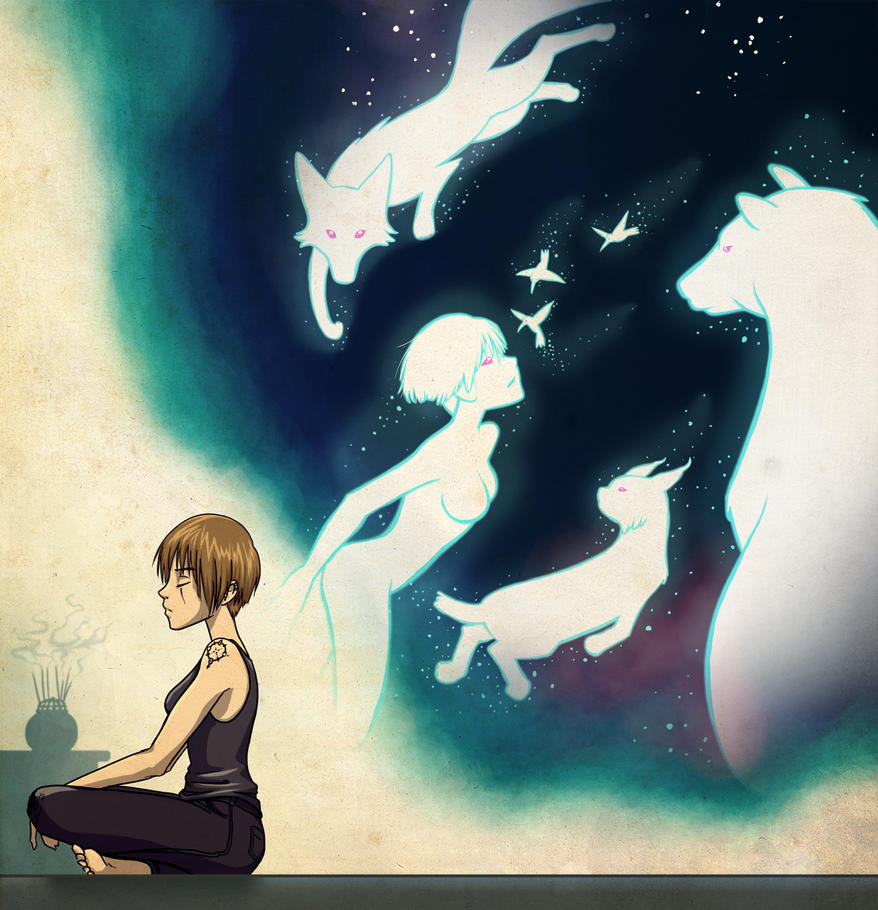
'Spiritual Journey' by Tamura @ dA
"The journey I conduct with students around the theme of waking the Sleeping Beauty is always one of the most important journeys, for it serves to rekindle the student's relationship with Puv, the Earth Spirit, via the Bari Washen Dai. It can help to develop essential assertiveness and also direction."


Patrick Jasper Lee, We Borrow the Earth: An Intimate Portrait of the Gypsy Shamanic Tradition and Culture (London: Thorsons, 2000), 222-224.

Sunday, 6 July 2014

The Richard Dawkins Book of Children's Stories

Private Eye - that brilliant, satirical magazine of current affairs - published a short piece on the Richard Dawkins fairytale story (Issue 1368, 13th - 26th June 2014). Here it is:

Exclusive serialisation of the book no one wants read to them 
THE RICHARD DAWKINS BOOK OF CHILDREN'S STORIES 
The Princess & the Frog 
Once upon a time, a beautiful Princess, who was looking for a Prince to marry, kissed a frog. Nothing happened - the statistical likelihood of morphogenesis is infinitesimally small. The members of the two different species, amphibian and mammalian, didn't actually live happily ever after because they're a figment of someone's imagination. The end. 
Jack & the Beanstalk 
Once upon a time, there was a boy called Jack who exchanged his family cow for a handful of "magic beans". His mother was very cross since there is no such thing as "magic", and she threw the beans out of the window. The next morning Jack awoke to find the beans hadn't even germinated yet. The end. 
Cinderella 
Once upon a time, there was a girl who was forced to work in the kitchens while her Ugly Sisters went to the ball. She was not visited by a Fairy Godmother since there are no such things as fairies and certainly no such thing as God. The pumpkin did not turn into a carriage because matter transmutation is not a scientifically viable concept. It was turned into a pie. The end. 
The Grouch who stole Christmas 
Once upon there was an evil Professor who had the magic power to suck the joy out of childhood by telling children there's no such thing as (I don't want to hear this, Ed.)


Thursday, 26 June 2014

Farewells and Returns

When one chapter ends, another one begins. So it is in books, and so it is in life.

My time in Brighton has come to a close after four years. I regret that while I was there I didn't allow myself to feel that it truly was my home - having itchy feet stopped me from wanting to feel like I was putting down roots. What I have come to see in retrospect is that I did put down roots, and these roots provided me with the nourishment I needed from the people and places around me. The wonderful friends, the vibrant city, the almighty sea, the blustery Downs and the embracing forests.


But Mole stood still a moment, held in thought. As one wakened suddenly from a beautiful dream, who struggles to recall it, but can recapture nothing but a dim sense of the beauty in it, the beauty! Till that, too, fades away in its turn, and the dreamer bitterly accepts the hard, cold waking and all its penalties.
From 'The Wind in the Willows' by Kenneth Grahame


This change has reminded me of the need to live more mindfully, alive in the present moment and respecting and enjoying what is around me, rather than spending all my time imagining or fretting about the future. 

I have now returned to London, a world away from the life I have been living and a past life I left behind purposely and eagerly. But I am here once again. And I must accept and make the most of my time here, in case I miss the roots growing, however temporary they may be...


There is always joy and wonder to be found, whether we're by sea and sand, amidst cars and crowds or alone on windswept moors.

And certainly with Luna, hiking the Downs...


And that is how I want to live my life: with joy and wonder.


And O most constant, yet most fickle Place,
Thou hast thy wayward moods, as thou dost show
To them who look not daily on thy face;
Who, being loved, in love no bounds dost know,
And say'st, when we forsake thee, 'Let them go!'
Thou easy-hearted Thing, with thy wild race
Of weeds and flowers, till we return be slow,
And travel with the year at a soft pace.
From 'Farewell' by William Wordsworth


Let's see how this chapter begins...

Saturday, 7 June 2014

Dawkins vs. Fairy Tales

Once again Richard Dawkins is causing controversy, this time on the subject of fairy tales. He recently called them 'pernicious' and speculated at the damage they cause to children's minds. After the (completely unsurprising) backlash, he retracted his statement and instead said that on balance they were probably OK because they could help with critical thinking skills. There's an article in The Telegraph about it here.

Critical thinking, and then some. At the heart of it, both science and fairy tales can help us to find answers about ourselves, in their own way. Both have the ability to fill us with a sense of wonder and awe. If a scientist had never been able to exercise her creativity and imagination, would she still be curious about the mysteries of the universe, and want to find answers?

If we had never imagined, wondered, been struck dumb by awe - if we had never dreamed and dared to ask why and how, there is no way we would have evolved to this point, to know so much. If we lived a life of facts and nothing else, how would we know to look beyond them?

The Mermaid, Howard Pyle, 1910. From ArtMagick.

Monday, 26 May 2014

British Folk Art exhibition @ Tate Britain

British Folk Art, 10 June - 31 August (Link)

A wonderful new exhibition is starting soon at Tate Britain in London - I can't wait! Alongside the exhibition there is also a whole host of courses, workshops and talks on folk art throughout June and July, which include collage, embroidery and knife-carving.

Goose Woman by George Smart c1840

From The Tate website:
Steeped in tradition and often created by self-taught artists and artisans, the often humble but always remarkable objects in this exhibition include everything from ships’ figureheads to quirky shop signs, Toby jugs to elaborately crafted quilts.
You will find an intricate sculpture of a cockerel, made out of mutton bones by French POWs during the Napoleonic wars. There is a larger-than-life-size figure of King Alfred made out of thatch. There are examples of the mysterious ‘god in a bottle’ – votive offerings suspended in bottles of clear liquid – as well as naïve paintings, tin trays covered with ornate fragments of crockery and much more besides. The show exemplifies the energy, variety and idiosyncracy of British Folk Art.
Folk art has often been neglected in the story of British art: by uncovering this treasure trove of folk art objects, this exhibition asks why.

Wednesday, 23 April 2014

Fairy Tales @ Brighton Fringe and Brighton Festival

It's that time of year again, folks. Where has the time gone? Next week is the start of Brighton Festival and Brighton Fringe, and the city will be filled with all manner of artistic, theatrical, musical and other events for a month.

Brighton Fringe is the largest arts festival in England and one of the largest fringe festivals in the world. Brighton Festival is the more 'grown up' celebration of all the same things as the fringe: music, theatre, dance, circus, art, film, literature and debate. The Festival's guest director this year is choreographer Hofesh Shechter, who follows in the footsteps of Michael Rosen, Vanessa Redgrave, Aung San Suu Kyi, Brian Eno and Anish Kapoor.

Here are the more magical and mystical offerings this year:

Monday, 17 March 2014

How Red Runs

I am somewhat late in sharing my most recent publication news: How Red Runs in Enchanted Conversation. I really am terrible at self-promotion! Thank you Kate for publishing it, and to the readers for the lovely comments; it's not often I get to see what people think of my work, it's exciting and also quite scary knowing I can find out what people think about my stories!

I remember incredibly clearly how How Red Runs came to be: I was on a much needed long walk through the woods with a great friend of mine and her beautiful labrador, Luna. Our walks there are like soul-therapy for me. I feel healed when I'm surrounded by nature.

I love watching Luna charging through the trees, like a pro slalom athlete, never missing a beat. It's something I'd love to be able to do, but I don't think human agility is really up to it at the speeds she travels! Being short sighted, I think I would be at an added disadvantage. The conversations my friend and I have on walks can take us anywhere, and today, before we parted ways, the conversation somehow turned to the subject of feral children.

I came home and tried to imagine myself back in the woods, this time not as an adult on a rejuvenating walk, but as a child: lost, alone, and looking for family. I imagined Luna running with her perfect dog-agility, and imagined trying to follow, unable to keep pace, stumbling, hurting...
'Romulus and Remus' by NauticalNymph on dA
In my writing, I tend to draw inspiration from fairy tales rather than re-work the stories themselves, but I have enjoyed this, and think it is something I will do more of~