Showing posts with label fairytales. Show all posts

Monday, 19 September 2016

Into the Forest

It has begun. I have stepped off the beaten track and away from everything familiar. I heard my name called in the sound of the wind rushing through leaves, shaking branches, whispering to me spirit to spirit. It has been coming for a while, and despite the months of anticipation and preparation, the first step was still a hesitant one.


Into the Forest | A.L. Loveday
'A road. For so long in my mind it had been an unquestioned symbol of travel, adventure and escape, but in reality it’s a lousy metaphor. A road is a tunnel that traps you in linear places, linear concepts and linear time. It provides ease and convenience, but cheats you of everything you might learn if you only had the time and curiosity to leave it.'
- From The Idle Traveller, by Dan Kieran -

I needed to leave, I knew, in order to find something I have long been searching for. I'd been unfurling tentative feelers for the past six years, both outward and inward, and the time had come to try and answer some questions and explore ideas that had captured my imagination.

Into the Forest | A.L. Loveday
'T.H. White's Arthur is sent to the forest to seek his identity; many children find woodlands the right place to go to talk to themselves, to dream themselves into a different being, to effect their changeling masquerades away from the eyes of adults. For under the gaze of others, a child can be forced to hold one form, to keep a single identity, but in woodshade and tree-shadow, a child's spirit can stretch, alter and change; it is always easier to change yourself in the dark.'

I am here to learn, to explore, and also to heal. I am here to work and to play. I am here to be alone with myself and engage in community. 


Into the Forest | A.L. Loveday
‘To know the woods and to love the woods is to embrace it all, the light and the dark -- the sun dappled glens and the rank, damp hollows; beech trees and bluebells and also the deadly fungi and poison oak. The dark of the woods represents the moon side of life: traumas and trials, failures and secrets, illness and other calamities. The things that change us, temper us, shape us; that if we're not careful defeat or destroy us...but if we pass through that dark place bravely, stubbornly, wisely, turn us all into heroes. ‘

And yet, despite all the fairy tale warnings, sometimes we're compelled to run to the dark of the woods, away from all that is safe and familiar -- driven by desperation, perhaps, or the lure of danger, or the need for change. Young heroes stray from the safe, well-trodden path through foolishness or despair...but perhaps also by canny premeditation, knowing that venturing into the great unknown is how lives are tranformed… 

Sara Maitland compares the transformational magic in fairy tales to the everyday magic that turns caterpillars into butterflies. "[S]omething very dreadful and frightening happens inside the chrysalis," she points out. "We use the word 'cocoon' now to mean a place of safety and escape, but in fact the caterpillar, having constructed its own grave, does not develop smoothly, growing wings onto its first body, but disintegrates entirely, breaking down into organic slime which then regenerates in a completely new form. It goes as a child into the dark place and is lost; it emerges as the princess, or proven hero. The forest is full of such magic, in reality and in the stories."'


If I have learnt anything from fairy tales, it is that you get nowhere in life without straying off the path, at least for a little while. The woods are there for you to lose yourself in, but, and this is the important thing, they are where we find ourselves again. We need the woods to become more than what we were.

Into the Forest | A.L. Loveday
‘We need the woods—the metaphor and symbol of the woods, the mythology of the woods. But all stories begin in a real place—as breath and movement in a physical space—and soak up the colour and texture of that place. When the woods are gone, the metaphors lose their power, the stories cease speaking from the silence of the trees.’
- Via Unsettling Wonder -  
We need our woods, but once again, they are under threat. The Forest of Dean, my home for the next few months, had not escaped the attention of gas-hungry predators; luckily, in the last couple of days, it has emerged that the companies in question have decided not to explore for gas. This is a huge relief. Our green spaces are sacred resources simply for being green, and the benefits they bring to us as they are should never be undervalued. 

I don't quite know what changes will occur, or what magic will happen here amongst the trees. But there's only one way to find out...


Friday, 13 May 2016

Timeless Tales: Psyche and Cupid

The latest issue of Timeless Tales Magazine has been released, and each of the wonderful stories and poems contained within is based on the myth of Psyche and Cupid.

It's a favourite tale-type of mine, with a heroine who travels across the world performing arduous and seemingly impossible tasks in order to save/reclaim her lost love. Sometimes she makes stupid mistakes, sometimes she makes selfish choices, but nevertheless she carries on undeterred until, finally, through a combination of her skill, determination and acceptance of help from others, she succeeds in her mission.

Anthony Van Dyck
Cupid and Psyche, by Anthony Van Dyck {Source}
I started reading mythology long after fairytales, but the stories are instantly recognisable, especially if you read around and outside the Disney canon. Reading Psyche and Cupid your mind will no doubt jump to all sorts of familiar stories; mine took me to Donkeyskin, The Six Swans, and Nix Naught Nothing

Editor Tahlia Merrill has ensured Timeless Tales is completely free to read online, however if you make a donation you are able to listen to the audio edition, too. This issue, I am narrating The River God's Bride by Donald Jacob Uitvlugt, who reimagines the myth in ancient Japan. So check it out, enjoy, and please consider donating to Timeless Tales so that Tahlia can keep on putting together this wonderful magazine and supporting her writers!

Timeless Tales Magazine: Psyche and Cupid issue #6
{Source}

Saturday, 23 April 2016

The Fairytales of Hermann Hesse

Once upon a time I thought my fairytale game was strong. Then I moved into a new flat - with a new flatmate - and discovered I was oh so wrong; I fortuitously stumbled upon a home filled with collections of fairy tales I might never have known about, along with bookshelves brimming with titles and authors that have been on my 'to be read' list for years, and now sit before me, inviting, waiting.

One of these glorious finds is The Fairytales of Hermann Hesse, translated and with an introduction by the one and only Jack Zipes.

The Fairytales of Hermann Hesse
{Source}
Hesse is one of those authors I have 'been meaning to get to' for at least ten years now, ever since my dad started sharing the titles of books that made a lasting impression on him when he was in his teens and twenties. I was poised to open Steppenwolf or Siddhartha - but then The Fairytales manifested before me. Bitesized stories, small in stature but so broad in nature; is there really a better way to get to the crux of a writer and their sense of the world than through fairytales? 

As Zipes points out in his introduction, the tales address modern 'obstacles like materialism, war, alienation, philistinism', themes that are as present and relevant today as they were when Hesse was writing in the post-war era. We gain insight into Hesse's understanding and experiences of these issues, and must examine our own at the same time. 

Zipes continues to say that '...even though many of his narratives are tragic, they leave us with a sense of longing, intended to arouse us so that we might contemplate changing those conditions that bring about the degradation of humanity'. Many of Hesse's characters navigate their estrangement from society only to die at the end of their journey; they gain some knowledge of 'the truth' but the price they pay is time to actually live it. But death is just part of the cycle: birth, death, rebirth. The old self - the old beliefs - have died...so how shall we rebirth ourselves to positively address our/humanity's obstacles? 

The protagonists' methods and attempts usually fail. They seek to dominate and reconstruct their realities with the power of cognitive thought, but this is not an act of mindfulness that can bring peace to themselves or others. Particularly in Augustus we see these characters positioned in contrast to a general population that embraces the wholeness of reality, that manages to find its happiness and accept pain and suffering at the same time. Perhaps these stories are about idealism vs dualism, or realism.

He was amazed each day to see how much misery there was in the world and yet how content people could be, and he found it splendid and inspiring to experience over and over again how sorrow could soon be followed by joyous laughter; a death knell by the song of children; every predicament and mean act, by simple kindness, a joke, a comforting word, or a smile (97/8)

Hermann Hesse
{Source}

The collection contains a broad spectrum of genres; some stories read like more 'traditional' tales (The Dwarf, or The Three Linden Trees, for example) while most others deviate into other literary realms. Zipes lists science fiction, the grotesque and macabre, romantic realism and dream-time stream of consciousness, which create a fascinating mix and make it much more interesting to read because we are being challenged to think and visualise in a different way with each tale.

It took me a few weeks to get through this (relatively short) book. The stories couldn't be rushed, and each needed to be digested before moving on to the next. Fairytales are magical in their ability to hold a mirror up to society, and they endure because the reflections are pertinent beyond the time of their creation. I felt Hesse's fairytales held a mirror up directly in front of me, not just society, and I wonder how transformative this will prove to be...

Tuesday, 2 February 2016

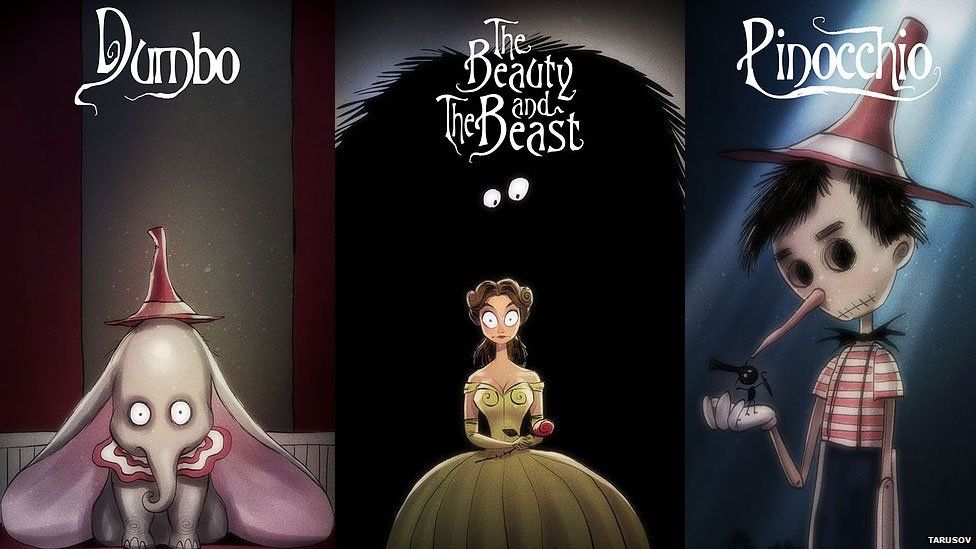
Disney images get the Tim Burton treatment

I stumbled upon this story on the BBC today: a Russian artist has reimagined classic Disney images in the haunting style of Tim Burton. The article says Burton is directing a live action remake of Dumbo, which I had no idea was in the works, but I can certainly see that coming together incredibly well; circuses have the classic creep factor about them, and I'm sure Burton will maximise on this!


Read the story above to see all the artwork. I think my favourite is the header image of Rafiki holding Simba aloft on that weird tree from A Nightmare Before Christmas - perfect!

Sunday, 30 August 2015

Song of the Sea: Silence, Suffering, and Sibling Bonds

Note: I began writing about the voices of Saoirse and Ben before my computer crashed and died, and I only discovered recently that I hadn't lost all my work (hurray!) However, the film is no longer fresh in my mind and my train of thought has very much been broken, so I apologise if my thoughts do not seem so fully formed. Also, this will contain spoilers.

*--------*


There is a lot of buzz about Song of the Sea at the moment, and rightly so: it is rich in folklore, deeply emotional and visually stunning - not that you would expect anything less from the creators of The Secret of Kells.

I will straight up admit that I am somewhat biased with my adoration of this film, because selkie tales in any form fascinate me. But Song of the Sea...it just 'got me' in that way that art grabs you sometimes. Certainly this was partly down to the distinctive artistic style, transporting us through the tale in a gentler way than the bright and flashy 3D animation we are used to these days. That haunting melody also completely captivated me. It gave me shivers.

But the film lingered with me, and made me think a lot more than most films about what it could be saying, and the wider issues it brought up for me.


One thing I was particularly interested in was the significance of Saoirse being unable to speak. Her silence is integral as a plot device because it gives Ben's human voice more importance in the world of faerie, but I'm curious about what it means symbolically too. The two relevant tales that spring to mind are Six Swans or Twelve Brothers, where a sister must not utter a word while she sews shirts made of nettle leaves in order to restore her brothers to human form; and of course The Little Mermaid, who trades her voice for legs in order to be with the man she has fallen in love with.

Both the sister in Six Swans and Andersen's Little Sea Maid are also in a state of constant pain along with their silence, the sister from handling nettle leaves and the sea maid from walking as if on knives. Although Saoirse is sick later on in the film, that particular physical suffering isn't part of the condition with the silence - I believe her pain is internal, from not knowing who she is or how to belong. She is a young girl who doesn't understand why she is different (a mythical struggle) or why her brother resents her and her father sends her away ('mundane', family struggle). Like the heroines in the other tales it is great love that spurs her on in her silent pain to overcome these challenges, and it isn't until the end when she reconciles with her mother and is able to make a decision of her own to remain with her father and brother that she begins to speak more freely.

Saoirse's freedom of choice is the big thing that differentiates her from the other two heroines, who both freely enter into magical contracts that require transitioning into their silence and pain from previous states where they enjoyed the reverse. Although these contracts have been interpreted in completely contrasting ways as signs of strength of will or symbols of female subservience, I think the lack of this initial reversal means we can overlook both of these in Saoirse's case if we choose: we can view it as growth, as a coming into the true self, and moving from a state of ignorance to knowledge of oneself and one's position in the world/family. 


Ben's voice is mistaken for the selkie's

Saoirse's silence allows the siblings to embark on the adventure together on a more even ground: she is a mythical creature who cannot speak and doesn't know the songs and stories she is expected to know, while Ben is a mundane creature with the faerie knowledge his sister requires. They are yin and yang, opposites that combine in a perfect whole.

His knowledge is also what keeps him safe. Selkie mother notwithstanding, Ben is a human child and would not under normal circumstances have such 'safe' access to the world of faerie, because, as well we know, fairies are dangerous and fickle creatures and an encounter with them can be deadly.


Anybody with a brother will have this family photo!

The human story of family ties and tragedy intertwines beautifully with the traditional folkloric elements, and you don't need to be an expert in Irish folklore to understand that. Selkie and water spirit tales often involve tragedy and heartbreak, and looking at Ben, I wonder if selkies are able to better connect on an emotional level rather than a purely imaginative level with children today in comparison to your classic wolves, witches and fairies. 


Ben's voice seems to be the voice of folklore in modern times, recalling the stories nostalgically at the same time as they breathe life into a new story, and a new moment of existence. His voice speaks for Saoirse, for the memory of his mother, but it is also our voice and the subtle reminder that we are constantly in dialogue with these tales, weaving them into our modern existence one way or another.

Monday, 16 February 2015

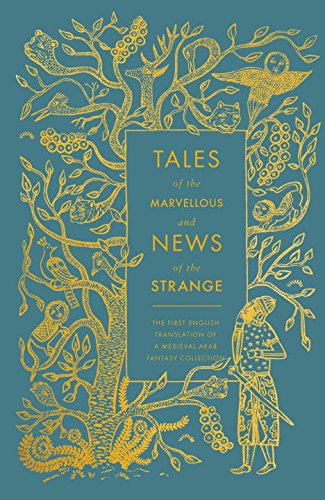
Tales of the Marvellous and News of the Strange

I'm wondering if anybody has read this book before? I came across it in an esoteric bookshop, and seeing it described as 'lost' stories that never made it into the Arabian Nights reminded me of the lost German fairytales discovered the other year. Are these stories really all surfacing at the same time...?


"On the shrouded corpse hung a tablet of green topaz with the inscription: 'I am Shaddad the Great. I conquered a thousand cities; a thousand white elephants were collected for me; I lived for a thousand years and my kingdom covered both east and west, but when death came to me nothing of all that I had gathered was of any avail. You who see me take heed: for Time is not to be trusted.'
Dating from at least a millennium ago, these are the earliest known Arabic short stories, surviving in a single, ragged manuscript in a library in Istanbul. Some found their way into The Arabian Nights but most have never been read in English before.Tales of the Marvellous and News of the Strange has monsters, lost princes, jewels beyond price, a princess turned into a gazelle, sword-wielding statues and shocking reversals of fortune."
(blurb taken from Amazon)


If anybody has read it I'd love to know what you thought! 

Thursday, 20 November 2014

Immerse yourself in Grimm

So THIS is happening in London until February next year...


Grimm tales (not the usual culprits either) in the form of immersive theatre at The Bargehouse. Exciting stuff!


WHAT TO EXPECT, FROM OUR CREATIVE PRODUCTION TEAM:


Philip Wilson (Director & Adapter):
"I love the fact that, in German, these are known as 'wonder tales' rather than the more twee term 'fairy tales': and so audiences coming to the Bargehouse will find themselves plunged into a parallel universe in which extraordinary adventures happen - and the darker side of these stories will come to light... "
Val Coward (Producer):
"We’re transplanting Pullman’s Grimm Tales into the raw, atmospheric rooms of the iconic Bargehouse. It’s a real flesh-and-blood rendering; you’re literally in the witch’s cottage with Hansel & Gretel and you can really sense the magic and delight in the players and audience as each story unfolds. We’re so excited to be bringing these tales to the South bank and everyone here will enjoy this, from kids and their grown-ups to the rest of us who enjoy a fantastic tale or two."

Saturday, 9 August 2014

A Gypsy shaman's interpretation of Sleeping Beauty

We Borrow the Earth fell off a shelf in a charity shop as I reached up to replace a book next to it. The title was captivating - so I decided the book had chosen me. I knew to ignore what I'd previously heard about Gypsy culture and tradition - the stories were likely overly romanticised and mysticised accounts - and aimed to read without preconceptions as far as possible. Patrick Jasper Lee's personal experiences and thoughts about his culture and history were fascinating and written in a very engaging manner. As a practising Gypsy shaman he has a deep relationship with the Earth, and a lot of his thoughts about our ruptured relationship with our natural world resonated with me.

But I was truly delighted to find he had expressed opinions on fairy tales and their importance in our (imaginative) lives - I'm not sure how often I've read interpretations that haven't been from a Western academic perspective. Below, I've shared Lee's thoughts on Sleeping Beauty.

'La belle au bois dormant' by manu4-20-5 @ dA
"It saddens me to think just how much we have pushed the fairy-tale world underground, this beautiful magical world which once fashioned everyday life and the initiations of our deeper past in Europe. But a student of mine once said to me, 'These Romani teachings of yours reawaken the Sleeping Beauty within me.' This comment could simply sound like romantic fantasy, but it touches the very heart of the Romani shamanic journey. The lady who spoke these words was French, but this phrase also says a good deal about the spirit of the imagination which once thrived in western Europe and which is now very much like a great and beautiful princess, sleeping within us, and also beneath us within the Earth."

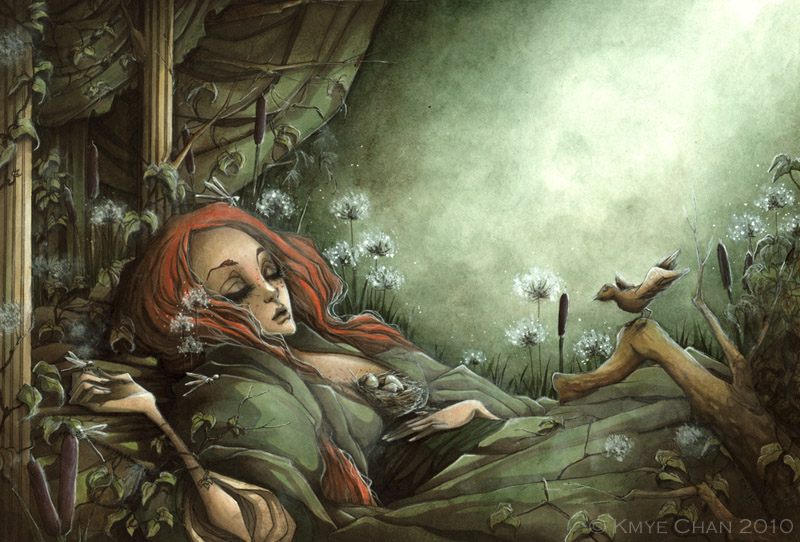
'The Sleeping Beauty' by KmyeChan @ dA
"Long ago, Sleeping Beauty, a spirit recognisable to all of us who have European roots, came under the spell of a wickedly clever fairy, whose spirit worked through many gullible sorcerers. These sorcerers threatened to kill the beautiful princess - or to take the beauty of the imagination away. The princess would prick her finger when she was 18 - civilised life would be a test for this natural spirit, nine being a crucial number for testing the soul of a great princess - and she and all her people would fall into a deep sleep in which they would know nothing of their older life, until a handsome prince found his way to the castle, kissed the princess and woke her. Then they would all live happily ever after - or reunite with their imaginative lives again. I believe we are still in that deep hypnotic slumber in our physical world, together with the beautiful Earth spirit, or princess of our land, and I believe that this seemingly eternal sleep affects us when we journey."

'Wild Nocturne' by lauraborealisis @ dA
"The Sleeping Beauty was thus a sad tale expressing the story of the Bari Weshen Dai, 'the Great Forest Mother', who was a beautiful feminine spirit residing in the forests of Europe. Her fate was sealed when the spell was cast. And she still now sleeps, entombed beneath the Earth, and also within us. Interestingly, in the French language The Sleeping Beauty is called La belle au bois dormant, 'The Beauty of the Sleeping Wood'!"

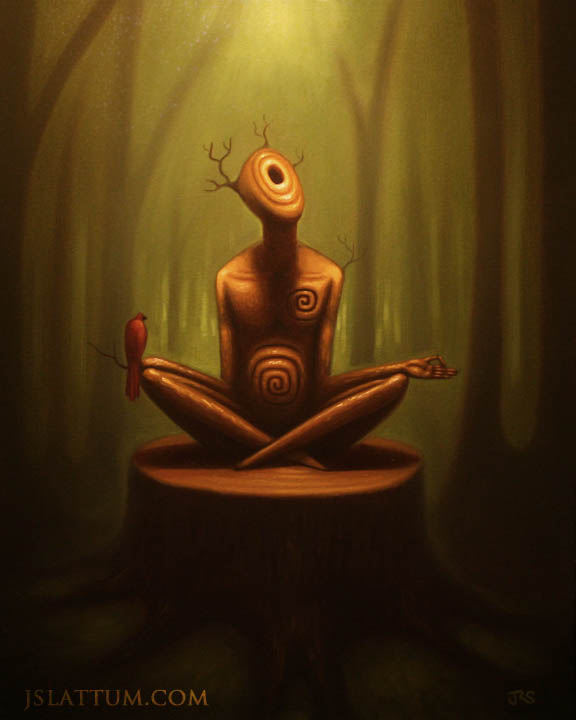
'Forest Thinking' by jslattum @ dA
"I often tell students who come to learn the craft of Romani journeying how we can take on the role of the handsome prince who kisses this beautiful lady. For a greater part of us is sleeping along with her, as we are all entranced by the spell. But when she wakes, in the future, we will wake too, and she will wake, because that is her fate also. No bad spell can last forever. The 'good' image must inevitably follow the 'bad' one! And we will eventually outwit the one who created this powerful soul-numbing slumber. Who knows what will happen when the Sleeping Beauty finally wakes!"

'Spiritual Journey' by Tamura @ dA
"The journey I conduct with students around the theme of waking the Sleeping Beauty is always one of the most important journeys, for it serves to rekindle the student's relationship with Puv, the Earth Spirit, via the Bari Washen Dai. It can help to develop essential assertiveness and also direction."


Patrick Jasper Lee, We Borrow the Earth: An Intimate Portrait of the Gypsy Shamanic Tradition and Culture (London: Thorsons, 2000), 222-224.

Sunday, 6 July 2014

The Richard Dawkins Book of Children's Stories

Private Eye - that brilliant, satirical magazine of current affairs - published a short piece on the Richard Dawkins fairytale story (Issue 1368, 13th - 26th June 2014). Here it is:

Exclusive serialisation of the book no one wants read to them 
THE RICHARD DAWKINS BOOK OF CHILDREN'S STORIES 
The Princess & the Frog 
Once upon a time, a beautiful Princess, who was looking for a Prince to marry, kissed a frog. Nothing happened - the statistical likelihood of morphogenesis is infinitesimally small. The members of the two different species, amphibian and mammalian, didn't actually live happily ever after because they're a figment of someone's imagination. The end. 
Jack & the Beanstalk 
Once upon a time, there was a boy called Jack who exchanged his family cow for a handful of "magic beans". His mother was very cross since there is no such thing as "magic", and she threw the beans out of the window. The next morning Jack awoke to find the beans hadn't even germinated yet. The end. 
Cinderella 
Once upon a time, there was a girl who was forced to work in the kitchens while her Ugly Sisters went to the ball. She was not visited by a Fairy Godmother since there are no such things as fairies and certainly no such thing as God. The pumpkin did not turn into a carriage because matter transmutation is not a scientifically viable concept. It was turned into a pie. The end. 
The Grouch who stole Christmas 
Once upon there was an evil Professor who had the magic power to suck the joy out of childhood by telling children there's no such thing as (I don't want to hear this, Ed.)


Saturday, 7 June 2014

Dawkins vs. Fairy Tales

Once again Richard Dawkins is causing controversy, this time on the subject of fairy tales. He recently called them 'pernicious' and speculated at the damage they cause to children's minds. After the (completely unsurprising) backlash, he retracted his statement and instead said that on balance they were probably OK because they could help with critical thinking skills. There's an article in The Telegraph about it here.

Critical thinking, and then some. At the heart of it, both science and fairy tales can help us to find answers about ourselves, in their own way. Both have the ability to fill us with a sense of wonder and awe. If a scientist had never been able to exercise her creativity and imagination, would she still be curious about the mysteries of the universe, and want to find answers?

If we had never imagined, wondered, been struck dumb by awe - if we had never dreamed and dared to ask why and how, there is no way we would have evolved to this point, to know so much. If we lived a life of facts and nothing else, how would we know to look beyond them?

The Mermaid, Howard Pyle, 1910. From ArtMagick.

Wednesday, 23 April 2014

Fairy Tales @ Brighton Fringe and Brighton Festival

It's that time of year again, folks. Where has the time gone? Next week is the start of Brighton Festival and Brighton Fringe, and the city will be filled with all manner of artistic, theatrical, musical and other events for a month.

Brighton Fringe is the largest arts festival in England and one of the largest fringe festivals in the world. Brighton Festival is the more 'grown up' celebration of all the same things as the fringe: music, theatre, dance, circus, art, film, literature and debate. The Festival's guest director this year is choreographer Hofesh Shechter, who follows in the footsteps of Michael Rosen, Vanessa Redgrave, Aung San Suu Kyi, Brian Eno and Anish Kapoor.

Here are the more magical and mystical offerings this year:

Monday, 17 March 2014

How Red Runs

I am somewhat late in sharing my most recent publication news: How Red Runs in Enchanted Conversation. I really am terrible at self-promotion! Thank you Kate for publishing it, and to the readers for the lovely comments; it's not often I get to see what people think of my work, it's exciting and also quite scary knowing I can find out what people think about my stories!

I remember incredibly clearly how How Red Runs came to be: I was on a much needed long walk through the woods with a great friend of mine and her beautiful labrador, Luna. Our walks there are like soul-therapy for me. I feel healed when I'm surrounded by nature.

I love watching Luna charging through the trees, like a pro slalom athlete, never missing a beat. It's something I'd love to be able to do, but I don't think human agility is really up to it at the speeds she travels! Being short sighted, I think I would be at an added disadvantage. The conversations my friend and I have on walks can take us anywhere, and today, before we parted ways, the conversation somehow turned to the subject of feral children.

I came home and tried to imagine myself back in the woods, this time not as an adult on a rejuvenating walk, but as a child: lost, alone, and looking for family. I imagined Luna running with her perfect dog-agility, and imagined trying to follow, unable to keep pace, stumbling, hurting...
'Romulus and Remus' by NauticalNymph on dA
In my writing, I tend to draw inspiration from fairy tales rather than re-work the stories themselves, but I have enjoyed this, and think it is something I will do more of~


Thursday, 7 November 2013

Twisted Tales

Remember Saints of the Lot called for fairy tale performers? Well, it's nearly time for their spectacular event: Twisted Tales!
Once in awhile in the middle of an ordinary life, Saints of the Lot gather a myriad of creative creatures to enchant our chosen kingdom. On Saturday, November 23rd, Saints of the Lot will be transforming the Marlborough Pub and Theatre into a Fairy Tale kingdom.
Snake Charmers, Flautists, Belly Dancing and Musicians fit for a king.
Big Brad Wolf and Acacia Blue will be teased and manipulated by the fairies of the forest in their provocative take on a Shakespearean tale.
Jack Woolley presents his fairy tale live alongside artistic projections by Elemental Media and a contemporary dance by Rochelle Joy portraying the lead Princess.
And so we embark into a land of fairies, witches, goblins and spells, we cordially invite you to our Twisted Tales.
Sounds exciting! You can buy tickets here.

Tuesday, 12 March 2013

Review: 'Mermaid' by Carolyn Turgeon

I love walking into my library and having a fairy tale retelling leap out of the stacks at me, rather than having to take a list and hunt around on the off chance that one might be stocked - this is exactly what happened to me with Mermaid. I wasn't looking for anything in particular, and there it was.

Sourced from the Author's website.
I should probably start by saying that I enjoyed reading this book. Too often the English student in me takes over my reviews with so much criticism that I read back over what I've written and wonder how I ever made it through the book in the first place! But I'm glad I've been trained to read with a critical eye. Yes, I have criticisms about this book, but that won't stop me recommending it purely on the basis that it is an enjoyable read.

Firstly, the blurb:
Two sheltered princesses, one wounded warrior; who will live happily ever after? 
Princess Margrethe has been hidden away while her kingdom is at war. One gloomy, windswept morning as she stands in a convent garden overlooking the icy sea, she witnesses a miracle: a glittering mermaid emerging from the waves, a nearly drowned man in her arms. By the time Margrethe reaches the shore, the mermaid has disappeared into the sea. As Margrethe nurses the handsome stranger back to health, she learns that not only is he a prince, he is also the son of her father’s greatest rival. Sure that the mermaid brought this man to her for a reason, Margrethe devises a plan to bring peace to her kingdom. 
Meanwhile, the mermaid princess Lenia longs to return to the human man she carried to safety. She is willing to trade her home, her voice, and even her health for legs and the chance to win his heart….

I have to admit the story is pretty predictable, and despite one slight twist on the original story (partly fuelled by the new character, Margrethe, and partly down to Lenia's actions) Andersen's classic is relatively untampered with. When I finished the book I felt cheated out of the promise that this would be a modern retelling. However, reading back over the reviews I noticed that, cleverly, the word 'modern' wasn't in fact used once, although 're-invention' and 'surprising take' were thrown around.

But then, if the original is so closely adhered to, how 'modern' can you make a story that values women differently? People talk about The Little Mermaid with affection for depicting a woman taking control of her life and pursuing her dreams...but ultimately this dream does not challenge the prevailing discourses that keep women in their proper place, as the Mermaid's desire is to become a wife. In Turgeon's retelling, the role of mother and wife is an unchallenged one; at first Margrethe seems 'modern' in that she has pursued education and takes an interest in politics (the era the book is set in marks this as unusual) but the second her position is threatened by another woman, her political motivations are forgotten amidst a delirium of jealousy, self loathing and body complexes.

Mermaid may not appeal to the feminist in me, but it does the aestheticist; there was a beauty in the imagery and at times a poetic lilt to the language, undoubtedly enhanced by the romantic settings (e.g. a convent on a stormy coastline at the edge of the world), that I would love to see more of in modern fiction.

Tuesday, 19 February 2013

Nix Nought Nothing: A Male Sleeping Beauty?

Having just finished reading Joseph Jacobs' English Fairy Tales I was particularly struck by one story: 'Nix Nought Nothing'. If you haven't read it, then you really must! It has everything a fairy tale needs!

The beginning resembles 'Beauty and the Beast', with a father unwittingly giving up his child to a giant:
At length the king was on his way back; but he had a big river to cross, and there was a whirlpool, and he could not get over the water. But a giant came up to him, and said "I'll carry you over." But the king said: "What's your pay?" "O give me Nix, Nought, Nothing, and I will carry you over the water on my back." The king had never heard that his son was called Nix Nought Nothing, and so he said: "O, I'll give you that and my thanks into the bargain."
Nix Nought Nothing lives with the giant for many years, and has adventures that will probably be familiar to most fairy tale enthusiasts: he is given three impossible tasks to complete and is helped by his captor's daughter, who he then runs away with. As they are pursued they throw ordinary objects behind them that turn into treacherous terrain for their father-captor-pursuer to cross. 

by Arthur Rackham. Source: SurLaLune
But it is the end of the story that surprised me, because beyond Sleeping Beauty/Snow White stories and their obvious variants, I have never before come across a scenario where a male hero must be rescued from an enchanted sleep.

So when [Nix Nought Nothing] asked his way to the castle [the hen wife] put a spell upon him, and when he got to the castle, no sooner was he let in than he fell down dead asleep upon a bench in the hall. The king and queen tried all they could do to wake him up, but all in vain. So the king promised that if any lady could wake him up she should marry him

In the end, he is woken by a gardener's daughter who the wicked hen-wfie taught the words to break the spell. But when the giant's daughter finds out what has happened she goes into the castle, tells the story of their adventures together and love for one another, and Nix Nought Nothing is able to remember her and confirm the story. The king and queen are sensible enough not to make good on a promise that would result in unhappiness (which in itself is a surprising turn on a familiar plot device) and allow their son and the giant's daughter to marry and 'live happy all their days'.

'Nix Nought Nothing' is such a varied story with so many interesting characters and twists on usual plot conventions, that it has instantly become one of my favourite fairy tales. But I would love to find out more about male characters being put into an enchanted sleep, if anybody can inform me, because this has really intrigued me!

*all quotes from SurLaLune

Friday, 8 February 2013

My first fairy tale

I had stories galore read to me when I was young, but my earliest memory of a fairy tale isn't from a book, but from an audio cassette. I remember listening to Roald Dahl's Revolting Rhymes (which you can read online here) when I went to bed, which was always a winner because my little brother loved to hear them too, and when you share a room it helps when you can agree on certain things! These stories scared me in a delightful way, because they were unusual and read out with strange voices, and with music as disjointed as the tales themselves. The music used to freak me out so much I would hide under the covers until the stories started being read out! 

I think they left a lasting impression...mostly because when I think of fairy tale justice, barrels of nails and iron shoes don't spring to mind first for me. No, I think of Little Red Riding Hood, who 'whips a pistol from her knickers, aims it at the creatures head, and bang! Bang! Bang! She shoots him dead.'


Recently I heard an old cassette recording of my brother and I playing when we were really little, I was probably only about 5 (cassettes seem to be playing a big part in my fairy tale memories!) I ask him if he wants a story read to him, and he says yes. So I say...'This one? OK. Once upon a time, Little Red Riding Hood, and that's the end, there isn't any more. Would you like another one? Yes? OK...' This happens about 10 times before mum gets tired of listening to me 'read' various stories to my brother, who loved that I was telling him so many! 

Looking/listening back at this makes me feel guilty. I was a bad big sister. But there's something else to it, too: I didn't need to tell the story. We'd heard them hundreds of times before, and we would hear them hundreds of times more throughout our childhood. Just saying the title, we knew there was a familiar story there. I'm kind of pleased I have this evidence of short changing my brother - it reminds me just how important and common and everyday these stories were in my childhood. And I'm truly grateful for that today.

Would anyone else be willing to share their fairy tale firsts?

Tuesday, 5 February 2013

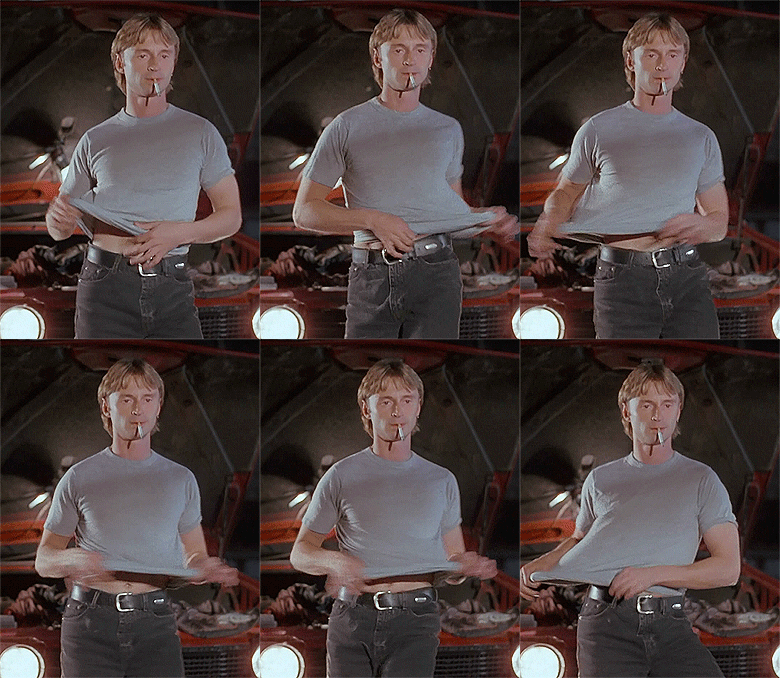
Once upon a strip tease...wait, what?

I watched the first episode of Once Upon a Time when it first aired in the UK last year; after reading so many positive reviews from American viewers, I was excited. But then...it just didn't grab me. I thought it was working far too hard to involve me and get me interested or to care about the characters. And I was gutted. I wanted to save myself from further disappointment so didn't try the next episode.

But last week I saw it was on TV again, so I had a quick look. And who did I see?


Yes please and thank you! That was it. I was hooked. Robert Carlyle makes that show for me! Coming in mid-series made the whole thing seem more natural (ignoring the incompatibility of costumes and accents) and I was able to pick it up pretty quickly.

I only have one problem now: I heard Donna Summer's Hot Stuff on the radio and got a vision of Rumpelstiltskin hip thrusting a la Full Monty. Well, I'll never be watching that film in the same way again!


Friday, 1 February 2013

public domain resource

After reading an article by Jack Zipes in The Public Domain Review I explored the site further and found that it is a beautiful resource for images, audio, film and text. For the fairy tale enthusiasts there is this page, which contains fantastic versions of Tennyson's Morte d'Arthur, Spencer's The Faerie Queene, and various collections of folk and fairy tales from around the world.

Source: Public Domain Review

Friday, 25 January 2013

Fairy tale symposium @ SCFFF

Old, New, Borrowed and Blue: A Fairy Tale Symposium
Tuesday 26th March, Bishop Otter campus, University of Chichester
Speakers: Jacqueline Simpson, Nicholas Tucker and Jack Zipes
A chance to see Jack Zipes give a lecture? Yes please! I am so thankful that I live close to the Sussex Centre for Folklore, Fairy Tales and Fantasy right now...not that I'm ever not thankful, of course. It seems that the event is free, so if this is only going to cost me a train ticket then I have no excuse for missing this!

Also, thanks to the SCFFF we can all read a new article about the Grimms by Jack Zipes here.

I am so full of fairy tale love right now <3 p="">

Tuesday, 22 January 2013

How much does happily-ever-after cost?


How many fairy tales do you encounter on a day to day basis? One? Two? Over a hundred, perhaps? In recent years I have noticed fairy tale imagery has had a massive resurgence in TV advertising, and as it has been suggested that we are subjected to hundreds - if not thousands - of adverts every day, our subconscious is probably inundated with happily-ever-afters off all shapes, sizes, and price ranges. 

It is unsurprising that companies use fairy tales as part of their marketing campaigns, as they create a sense of whimsical desire and romantic idealism. In the UK, I have noticed the appearance of fairy tales most in association with household cleaning products. Women are still the main targets of these adverts, as the assumption is that they do the majority of the housework. Cinderella, anyone? Cinderella slaved away for a long time, but eventually met her prince and found happiness. Regular women don't have such high expectations, but if the brand can make a woman relate to Cinderella somehow, she will associate their product with an easier life, a more accessible happily ever after.
See for example Cif and Vanish (which takes a slightly different approach, and shows the male cleaner as the woman's hero).

Cinderella is also famous for travelling to her ball in a pumpkin...but Go Compare picked up on the fact that the fairy godmother forgot to insure it!
'Change' is a recurring theme in fairy tales: there are rags to riches transformations, changes of affections, changes of states (eternal sleep to life, frog to prince...) We all want positive changes in our lives, so, how about faster broadband from Sky?

Pretty much anything can have a fairy tale angle found for it, whether its foodadventures far, far away, or just wanting to feel a bit more like a princess

And TV will always be suited to fairy tales: it is an easy form of escapism and entertainment, which are the main reasons we first come into contact with these stories, as children. TV viewers agree to suspend their belief in reality and presumably can remember being a child, a period in life when inhabiting alternate realities was far more common. With nostalgia thrown into the mix as well, the marketing teams are laughing.

Myth and magic continue to be a part of our daily lives, even if they don't appear in the most expected ways. It could be argued that fairy tales in adverts are just another fad, responding to the many new films, books and television shows, or going for the optimistic outlook in times of global financial hardship. It could be any number of reasons, yet at the same time, there is only one reason: be it in a big way or small, fairy tales will always be a part of our lives, and until we give up the quest for love, for riches, for happiness, or the fight for good to triumph over evil, chances are, they always will be. We just have to get used to seeing them in odd places...