Showing posts with label films. Show all posts

Tuesday, 2 February 2016

Disney images get the Tim Burton treatment

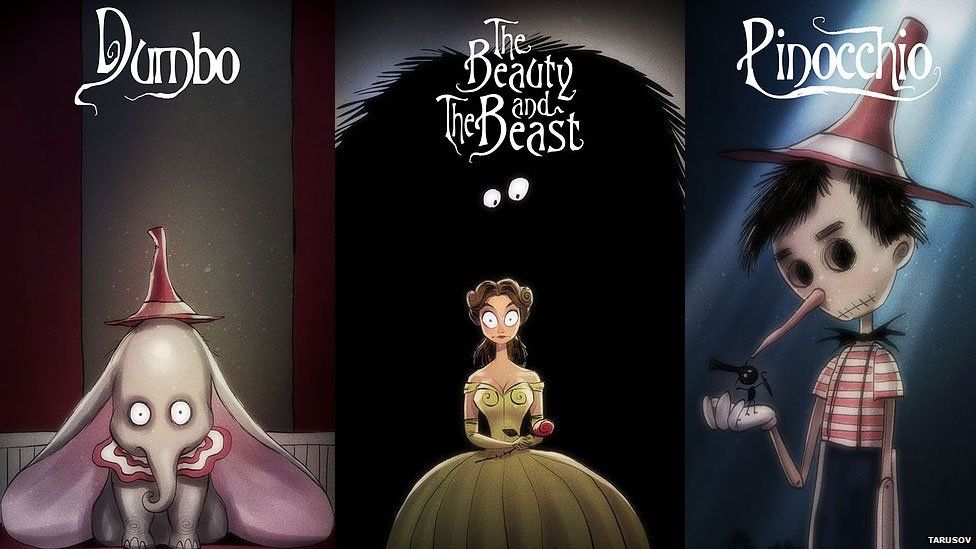
I stumbled upon this story on the BBC today: a Russian artist has reimagined classic Disney images in the haunting style of Tim Burton. The article says Burton is directing a live action remake of Dumbo, which I had no idea was in the works, but I can certainly see that coming together incredibly well; circuses have the classic creep factor about them, and I'm sure Burton will maximise on this!


Read the story above to see all the artwork. I think my favourite is the header image of Rafiki holding Simba aloft on that weird tree from A Nightmare Before Christmas - perfect!

Sunday, 30 August 2015

Song of the Sea: Silence, Suffering, and Sibling Bonds

Note: I began writing about the voices of Saoirse and Ben before my computer crashed and died, and I only discovered recently that I hadn't lost all my work (hurray!) However, the film is no longer fresh in my mind and my train of thought has very much been broken, so I apologise if my thoughts do not seem so fully formed. Also, this will contain spoilers.

*--------*


There is a lot of buzz about Song of the Sea at the moment, and rightly so: it is rich in folklore, deeply emotional and visually stunning - not that you would expect anything less from the creators of The Secret of Kells.

I will straight up admit that I am somewhat biased with my adoration of this film, because selkie tales in any form fascinate me. But Song of the Sea...it just 'got me' in that way that art grabs you sometimes. Certainly this was partly down to the distinctive artistic style, transporting us through the tale in a gentler way than the bright and flashy 3D animation we are used to these days. That haunting melody also completely captivated me. It gave me shivers.

But the film lingered with me, and made me think a lot more than most films about what it could be saying, and the wider issues it brought up for me.


One thing I was particularly interested in was the significance of Saoirse being unable to speak. Her silence is integral as a plot device because it gives Ben's human voice more importance in the world of faerie, but I'm curious about what it means symbolically too. The two relevant tales that spring to mind are Six Swans or Twelve Brothers, where a sister must not utter a word while she sews shirts made of nettle leaves in order to restore her brothers to human form; and of course The Little Mermaid, who trades her voice for legs in order to be with the man she has fallen in love with.

Both the sister in Six Swans and Andersen's Little Sea Maid are also in a state of constant pain along with their silence, the sister from handling nettle leaves and the sea maid from walking as if on knives. Although Saoirse is sick later on in the film, that particular physical suffering isn't part of the condition with the silence - I believe her pain is internal, from not knowing who she is or how to belong. She is a young girl who doesn't understand why she is different (a mythical struggle) or why her brother resents her and her father sends her away ('mundane', family struggle). Like the heroines in the other tales it is great love that spurs her on in her silent pain to overcome these challenges, and it isn't until the end when she reconciles with her mother and is able to make a decision of her own to remain with her father and brother that she begins to speak more freely.

Saoirse's freedom of choice is the big thing that differentiates her from the other two heroines, who both freely enter into magical contracts that require transitioning into their silence and pain from previous states where they enjoyed the reverse. Although these contracts have been interpreted in completely contrasting ways as signs of strength of will or symbols of female subservience, I think the lack of this initial reversal means we can overlook both of these in Saoirse's case if we choose: we can view it as growth, as a coming into the true self, and moving from a state of ignorance to knowledge of oneself and one's position in the world/family. 


Ben's voice is mistaken for the selkie's

Saoirse's silence allows the siblings to embark on the adventure together on a more even ground: she is a mythical creature who cannot speak and doesn't know the songs and stories she is expected to know, while Ben is a mundane creature with the faerie knowledge his sister requires. They are yin and yang, opposites that combine in a perfect whole.

His knowledge is also what keeps him safe. Selkie mother notwithstanding, Ben is a human child and would not under normal circumstances have such 'safe' access to the world of faerie, because, as well we know, fairies are dangerous and fickle creatures and an encounter with them can be deadly.


Anybody with a brother will have this family photo!

The human story of family ties and tragedy intertwines beautifully with the traditional folkloric elements, and you don't need to be an expert in Irish folklore to understand that. Selkie and water spirit tales often involve tragedy and heartbreak, and looking at Ben, I wonder if selkies are able to better connect on an emotional level rather than a purely imaginative level with children today in comparison to your classic wolves, witches and fairies. 


Ben's voice seems to be the voice of folklore in modern times, recalling the stories nostalgically at the same time as they breathe life into a new story, and a new moment of existence. His voice speaks for Saoirse, for the memory of his mother, but it is also our voice and the subtle reminder that we are constantly in dialogue with these tales, weaving them into our modern existence one way or another.

Friday, 15 May 2015

Tale of Tales: the latest fairy tale film offering

Tale of Tales is being lauded as the star of Cannes, according to The Guardian, and on the spectrum of fairy tale adaptations it falls easily on to the side of dark and creepy. 

This is not a retelling of a popular tale or an angsty examination of a misunderstood villain; instead it is a collection of stories based on the seventeenth century writings of Giambattista Basile, who predates more familliar household names such as Grimm, Andersen or Perrault.

The full review in The Guardian can be read here. It sounds like the sort of off-beat comedy that will perfectly complement the ridiculous and macabre storylines that are often seen in fairy tales, but mostly ignored in popular culture. I wonder if it marks the start of a new direction for film adaptations?


Saturday, 16 February 2013

The Folk Heritage of Fantasia

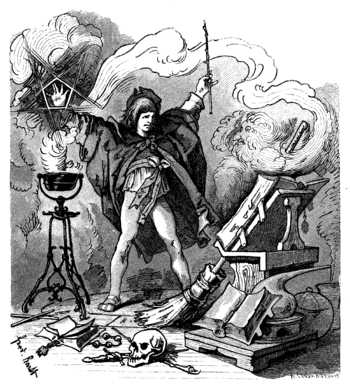
I'm sure we've all watched and enjoyed Fantasia at some point, haven't we? The star of the show, without a doubt, is Disney's own Mickey Mouse in The Sorcerer's Apprentice, based on a poem by the famous German writer Goethe.

It is the story of a foolish young apprentice who decides to mess around with his master's book of magic, and ends up getting himself into danger; luckily his master arrives in the nick of time and is able to save him from drowning.

Source
I was rather surprised to come across this story as part of Joseph Jacob's collection of English Fairy Tales, under the heading The Master and His Pupil. It is the same basic story, except that instead of the apprentice enchanting a broom, he accidentally summons the Devil and has to set him tasks to avoid being strangled. In a panic, the apprentice tells the Devil to water a flower, but he keeps bringing barrel after barrel of water into the home and flooding the house. Just when the water level is about to rise above the apprentice's chin, the master comes home and sends the Devil back where he came from.

Jacobs published his collection in 1890 and states that his source is an 1866 collection of traditional folk tales from the Northern counties of England (Yorkshire is named in the text). Goethe's poem was published a hundred years earlier. It will never cease to amaze me how far through space and time these stories have travelled.


Friday, 1 February 2013

public domain resource

After reading an article by Jack Zipes in The Public Domain Review I explored the site further and found that it is a beautiful resource for images, audio, film and text. For the fairy tale enthusiasts there is this page, which contains fantastic versions of Tennyson's Morte d'Arthur, Spencer's The Faerie Queene, and various collections of folk and fairy tales from around the world.

Source: Public Domain Review

Sunday, 22 January 2012

The Hobbit

Have we all seen the trailer yet?!


Tolkien was a genius, and I'm glad Peter Jackson had the ambition to bring that genius to a new audience on the big screen. I'm excited for the release, especially after all the stopping and starting the production went through, and it will be nice to see more of Bilbo.


Now seems to be a great time for fantasy novels to appear on the big screen, as special effects and animation have become so advanced; the magic can be recreated without awkward distractions, such as seeing the cables allowing a person to 'fly', or an ill-fitting mouthful of vampire fangs that probably wouldn't even pass quality control in a joke shop (Christopher Lee...)


Obviously a lot had to be cut out of LotR (and there was nothing special effects could do about that!) but I think it is impressive how well Jackson managed to use the stories to make such thrilling and enchanting films. Not all books are in such safe hands, and some real treasures have been ruined by bad acting, cheesy sfx and/or mutilated storylines. I'm sure we all have our pet hates, especially if the book meant a lot personally. Mine is The Chronicles of Narnia: The Lion, The Witch and The Wardrobe. But...that's a story for another time.


I know I have nearly another whole year to wait, but I don't think any film will get me as excited as The Hobbit in 2012.


Because I'm feeling excited, a bit geeky and nostalgic about the time I read The Hobbit under the duvet with a torch as a kid, I'm ending this post with my favourite of the riddles in the dark...


This thing all things devours:
Birds, beasts, trees, flowers;
Gnaws iron, bites steel;
Grinds hard stones to meal;
Slays king, ruins town,
And beats high mountain down.