Friday, 11 January 2013

Exploring the Forest

For Christmas this year I received a truly inspirational present: Gossip from the Forest by Sara Maitland. Although I was lucky enough to be given several books, this is the one I couldn't resist delving into first, and I was instantly hooked. I am now halfway through and loving every page!

Source: Waterstones
Each chapter is devoted to a specific forest Maitland is exploring, and her writing seems to effortlessly mimic a chain of thought that links types of trees, the forestry-oriented history of the country, and of course the relationship with fairy tales. The chapters on the woods are interspersed with interesting re-tellings of fairy tales that draw their magic from this landscape: one that stands out for me is her version of Hansel and Gretel, which deviates completely from the familiar tale and instead examines their lives as adults, coping with what went on in the darkest depths of the trees...

The most wonderful discovery so far is a chapter entirely devoted to the very part of London I grew up in - turns out my neighbourhood, West Norwood, gets its name from a contraction of 'North Wood', which covered a vast expanse of what is now south London. Reading about the history of a place I know so intimately has caused a stir inside me: I literally grew up on the long lost roots of ancient woodland! Whenever I go into green spaces, especially woods, I feel so alive and free in a way that is hard to express, but which I want to channel in order to create some interesting writing for THCV...

So, inspired by Maitland and my own woodland adventures, I have decided to dedicate a series of posts to exploring the forest and our links to them in fairy tales and books in general. I want to pick up on some ideas Maitland posits, look at specific books that capture the magic of the forests, and hopefully go on my own version of a forest adventure...


Tuesday, 8 January 2013

A.S. Byatt and That Fairy Tale Feeling

After promising to provide more exploratory posts this year, I am kicking off 2013 with something I have been working on for a while, trying to find the best words and phrases to translate my vague feelings into something tangible...

Please let me know your thoughts! Not just on the content, I'd also like to hear your opinions on the length as this piece is over 1000 words. Does this work on a blog?

A.S. Byatt and That Fairy Tale Feeling

I have been puzzling over 'that fairy tale feeling', the one that takes hold of me whenever I read the fairy tales I grew up with, instantly transforming me into a child again. After puzzling away for a good long time, I started to wonder whether 'that fairy tale feeling' is a certain lack of emotion, or sense of detachment.

These terms may sound quite negative, or like an accusation, but I am referring to writing style rather than substance. I think it exists subtly within most stories, although I would say it is most recognisable in the Grimm's collections, as they are based on the oral tradition. This detachment allows the stories to exist as  just something that happened, once upon a time. 


Detachment in fairy tales

I came across A.S. Byatt's The Children's Book as I began writing this, and was delighted to find Byatt had put across her ideas about fairy tales through her characters, who were also struggling to articulate 'that' feeling:
Griselda said that her aunt's fairy stories frightened her. So did Hans Andersen, he made her cry. But not this sort of tale. She didn't know why. It should be scary, there was a lot of blood. Toby said these were memories of some other time, long ago, and he agreed, they weren't scary. 
"They are just like that," said Griselda, feeling for what intrigued her, not finding it. [pp 51-2]
They are what they are, just something that happened, once upon a time. In this quote, Griselda has seen the Brothers Grimm version of 'Cinderella' acted by marionettes, and recognises it, yet doesn't recognise it, as she is used to the version by Charles Perrault, 'whose stories were written for young ladies, and usually had fairy godmothers.'

When fairy tales are 'designed', regardless of who they are designed for, that sense of detachment is in danger of becoming lost due to the intent within the words, the desire to steer emotions and beliefs towards a particular way of thinking. The Grimms may have had an audience in mind, albeit different to Perrault's, but their 'detachment' allowed Griselda to see the story through her own eyes rather than through theirs, and saved her the pain of emotional blackmail that she feels from reading Andersen.

image sourced here
Later, Griselda goes on to study fairy tales at Cambridge; she wants to know why they aren't just myths, how the versions of tales are the same and also different, and what the rules are that they follow. She discusses her decision to do this with her friend Julian:
"That's another thing I want to study. I don't think the real tales do frighten you. I think you accept the rules. They work in a fenced world which isn't the real world, where nothing ever really changes. Witches get punished, and goose-girls become princesses, and what was lost is restored." 
"I don't know. I was particularly horrified as a small brat by the eyeballs stuck on the thorns, or the dead men impaled on a fence round the glass hill, or the witch in the barrel full of nails." 
"I would suggest it was a kind of gleeful horror? Whereas H.C. Andersen's stories do hurt the reader. The Little Mermaid walking on knives and losing her tongue." [p488]
Byatt, A.S., The Children's Book. London: Chatto & Windus, 2009.

Griselda's opinions on Andersen seem to mirror Byatt's own. In an article for The Guardian newspaper, she says:
From very early I had an unthinking category in my mind of the "real"(authentic) fairy tale which centred on the brothers Grimm, and some of the Nordic stories collected by Asbjørnsen. It included some of Perrault and some English tales - "Jack and the Beanstalk", for instance. These tales might be funny or horrible or weird or abrupt, but were never disturbing, they never twisted your spirit with sick terror as Andersen so easily did. They had a discrete, salutary flatness. [italics my own]
So Byatt/Griselda states that the 'detachment' is due to an understanding that the story takes place in a world with generally accepted rules. Byatt has named what I call 'lack of feeling' as 'flatness'. She also says, 'Character feels wrong in folktales' after explaining that it would be impossible to actually fall in love with Little Red Riding Hood because she has a series of boxed in, finite gestures. She talks about the link between the 'impersonal oral and the 'authored' story with psychology,' and explains how the Grimms tip the balance more towards oral, and Andersen towards psychological, which is why his stories are more damaging. 

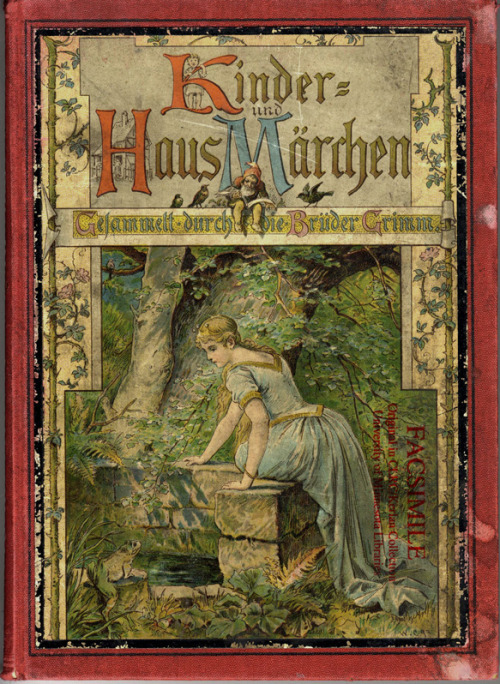
We know that the Grimms, who first published Kinder-und Haus-Märchen in 1812, went back and re-wrote their stories in later years to imbue them with more family-friendly, middle-class values. However, because they remain more true to the oral tradition, their stories retain that sense of 'detachment' that is lost in a more authored story.

1857 cover. Source.

Detachment in the modern world

This 'detachment' is relevant beyond my attempt to understand a vague feeling that came over me as a child: it is relevant to those people in contemporary life who are part of current debates, and those who continue writing in the fairy tale tradition.

It has been much reported in the news recently how parents are up in arms about the 'damaging' effects that fairy tales are supposed to have on children, because they are full of cruelty, murder and violent justice. I can see where they are coming from, but I don't believe their claims take the bigger picture into consideration. 


It seems to me that fairy tales with this 'flatness' or 'detachment' allow a child to understand that what transpires is just something that happened, once upon a time. They may not guide a child to take sides with the good guys, but then again these tales aren't always in black and white. They're not Aesop's Fables with a clear moral at the end; their original purpose was entertainment, but equally, that doesn't mean there aren't one or two lessons to pick up along the way. 'Fairy tales' has been used as an umbrella heading in this attack that doesn't take into consideration the wide variety of stories out there.  


The 'Shrek' movies gave new personalities to popular princesses.
Image sourced here
'Detachment' also allows new authors of fairy tales and fairy tale inspired work to re-examine the stories. Writing in the 'authored' style we fill in the gaps that weren't considered gaps when we heard these stories as children, and ask questions that don't need to be answered to keep the original tale credible. We extend them, look at them from different angles and get under characters' skins in a way that perhaps wouldn't be so possible if these stories were completely authored or 'attached' in the first place.


And why do we writers and readers continue to delve into these worlds, which are 'flat', 'boxed in' and where 'character feels wrong'? I think the true magic of this detachment is that it has allowed us all, no matter our age, to be permanently enchanted by events that just happened, once upon a time.

Sunday, 30 December 2012

Marina Warner's Grimm Thoughts

Here is a link to BBC4's series 'Grimm Thoughts', where Marina Warner discusses various aspects of Grimm, including origins of specific tales, links to real people, what happened during the Nazi period, censorship, modern influence, and much more.

Some of the programmes are still available in full, others only have short clips up to listen to. I hope you can listen to these outside the UK!

Thursday, 13 December 2012

Grimm Wallpapers

This is a quick feature on Corey Godby, a talented artist who has released a series of beautiful digital paintings based on Grimm and other folk tales, and has put them up for free download (or offer a donation!) on his website. You can download the wallpapers here, visit his website here, or take a look at his blog here.

LRRH by Corey Godby

Monday, 10 December 2012

There's something wrong with Gwen...

Angel Coulby as Guinevere in BBC's 'Merlin'
Readers, as you'll have noticed by now, I love my legends of King Arthur. I moaned about 'Camelot' as I re-discovered and enjoyed 'Merlin', and I couldn't believe it when I found out Caerleon was IS Camelot. Apologies to the readers who follow for fairy tale or writing related ramblings, but this is a 'Merlin'-related rant (that may contain spoilers, so be warned!) about feminism and the depiction of women on TV.

So...anyone noticed that something is wrong with Gwen? I don't mean the way she was brainwashed by Morgana, I mean before that. And after that. The girl who was so active, so passionate, and so kind to everyone in the previous series has become passive and distant now that she has married. I used to think it was very cool to show a woman who deserved to become queen, who lived her life like a queen even though she was a servant. But now...Gwen has become Arthur's accessory.

She sits meekly at Arthur's side and does nothing. She doesn't talk kindly (at all, really) to Merlin, even though they were friends. And she has lost her passion and compassion (I'm thinking about how she obediently 'performed her duty' of sentencing a young girl to be executed. She tried to alleviate her conscience by taking a chance on the fact that the girl's father would show up and try to rescue her, which is a far cry from actually standing up for what she believed in, which is that the girl was innocent.)

Katie McGrath as Morgana
Strangely enough, when Morgana brainwashed her in that dark tower, Gwen became more like the person she used to be. She began to sneak around, actively trying to accomplish what she believed in. She acknowledged her roots, the fact that she came from a 'normal' background. She took the time to relate to Morgana and feel her pain, wanting to bring her justice, unlike the girl she sentenced to be executed, whose pain she wanted to ignore and whose fate she wanted to leave to chance.

Of course, Merlin and Arthur saved the day and 'cured' Gwen. She went back to being the docile, passive woman they had grown accustomed to. Unsurprisingly, that was the end of Gwen as a prominent part of the storyline. And did anything come of it? Well...she did say 'thank you' to Merlin, I suppose.

I feel this brings up the familiar discussions about women giving up their lives when they become married, and of the women in stories who are dangerous purely because they have agency. But what really makes me cross this time is that the BBC has shamelessly and clearly shown Gwen change from strong to weak, active to passive, admirable to deplorable. This is a children's show, it has a 19:30 time slot, and the ONLY female character who represents the force for good is sitting around looking pretty. So much for the role model.


Saturday, 1 December 2012

Mirror Dance is up!

The Winter 2012 issue of Mirror Dance has gone up, and I'm thrilled that my short story, Goodnight, Sweet Lady, has been included in this issue! It's also fantastic to be published alongside L.C. Ricardo of Spinning Straw Into Gold, whose writing on and dedication to fairy tales I greatly admire. Make sure to have a look at all the wonderful work published, and if you like what you read then please leave a comment, however brief, as I know it will be appreciated by the authors.

Have a lovely weekend everyone, and enjoy the snow if you're lucky enough to be in the right part of the country for it!

Tuesday, 27 November 2012

Upcoming publication: Old Oak & The Maiden

Wow, two acceptances this month! I'm thrilled that Old Oak & The Maiden has been accepted for publication in Scheherezade's Bequest! This really is so exciting for me: when I began writing and attempting to get my stories published two years ago, one of the first submissions I made was to SB. It was, unsurprisingly, rejected. And now, to have a story accepted by them...it's something I can clearly measure my success against, you know?

I'm always disappointed that as someone who wants to use words to make a living, I never find the right ones to express myself properly when I'm overexcited!

Anyway...it will be published (in print!) in Spring 2013.

I posted an excerpt on a previous blog post, which you can read here if you're interested...